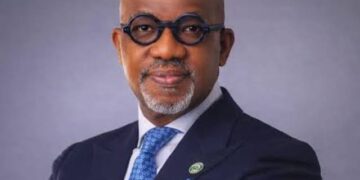




A former Minister of State for Finance, Budget and National Planning, Clement Agba, has stated that the Federal Government bears no responsibility for the 133 million Nigerians currently living in multi-dimensional poverty.
Speaking in a video presentation shared on X by Presidential Aide Bayo Onanuga on Wednesday, Agba argued that the duty of lifting citizens out of poverty lies with sub-national governments, including state and local authorities.
Agba, who oversaw the 2022 National Multidimensional Poverty Index survey, explained that while financial poverty measures those living on less than $2 a day, multi-dimensional poverty reflects the lack of access to basic amenities such as education, healthcare, potable water, and sanitation.
He said, “The truth, from what the survey showed, is that the Federal Government has nothing to do with multi-dimensional poverty. I’ve seen a lot of people talk about this, that Buhari did increase the number of poor people in Nigeria, or Tinubu has done so. It has nothing whatsoever.”
The former minister criticised state governors for focusing resources on urban centres while neglecting rural areas where the majority of Nigerians live.
He added, “Our governors, when they need the office, remember their entire state. They go around and campaign. But once they win, they put 80% or so of the resources into the state capitals. If you have all the money in the world and you go to your community, and you fall ill at night and there is no one available, you are multi-dimensionally poor, even if you have ten million dollars in your pocket.”
Defending the current administration’s economic policies, Agba likened the removal of the fuel subsidy to a necessary medical procedure, insisting that the temporary discomfort is a prerequisite for long-term stability.
He said, “When you get really sick, when you have cancer, what do you do? You just manage the pain, or you cut it off? You cut it off, right? And once you do that, there must be pain, but you endure the pain for a while, and thereafter things begin to manifest. We all want to have an omelette, but no one wants to break eggs. I think now is the time to break the eggs so that we can have a future.”
Agba also urged that the Open Government Partnership (OGP) initiative remains funded to foster transparency, calling on his successor and the Minister of Youth to ensure the programme is included in the national budget.
Unlike monetary poverty, which only measures income, multi-dimensional poverty looks at multiple deprivations a person experiences simultaneously.
According to the 2022 survey supervised by Agba, 63% of Nigerians, representing 133 million people, are multi-dimensionally poor.
The index uses 15 indicators across health, education, living standards, work, and economic shocks.