



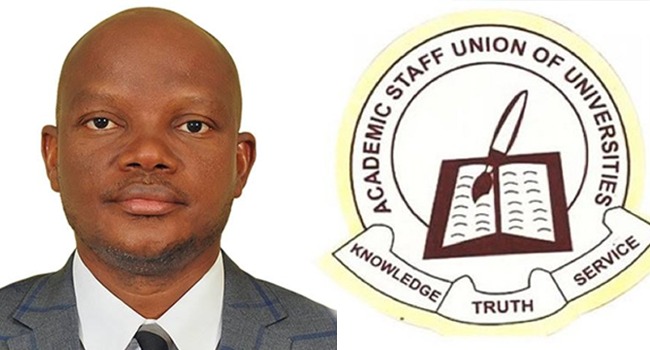
The Academic Staff Union of Universities (ASUU) has raised concerns over the slow implementation of the 2025 agreement reached with the Federal Government, warning that unresolved issues could trigger another disruption of academic activities.
ASUU President, Prof. Chris Piwuna, disclosed this on Wednesday while speaking on Frontline, a current affairs programme on Eagle 102.5 FM, Ilese-Ijebu, Ogun State.
Piwuna said the union had expected the government to have made substantial progress in implementing the agreement signed in December 2025, rather than still addressing outstanding provisions nearly a year later.
“It is really painful to have conversations like this in this manner. Our expectation when we signed an agreement in December 2025 was that we are going at this time telling about progress that we have made to stability in the system and concern ourselves with issues that affect Nigerians,” he said.
According to him, the agreement covered funding for public universities, improved salaries and support for research, among other provisions.
He, however, said some of the provisions had yet to be properly implemented, resulting in difficulties for some universities and their workers.
“The agreement, when we signed it, had provision for funding for public universities. It had provisions for improved salary, and it had provision for research council, amongst others,” Piwuna said.
The ASUU president alleged that inadequate implementation had affected salary payments in some universities, with some institutions reportedly unable to fully adopt the new salary structure.
“As we stand now, funding is not properly being done according to what was agreed to. Individual universities have to embark on strike before salaries are being paid. Some universities are cut off from the new salary structure,” he said.
Piwuna said the union had not abandoned dialogue, noting that ASUU had held several meetings with government officials and written letters concerning the outstanding issues.
“There are several engagements and several letters written,” he said.
He also said the responsibility for implementing the agreement was not limited to the Federal Government, explaining that state governments running public universities also had obligations under the agreement.
Piwuna, however, acknowledged that some state governors had implemented the provisions, citing Abia State Governor, Alex Otti, as one of those who had fully embraced the agreement.
On university funding, the ASUU president called for increased government investment in education, arguing that adequate funding was necessary for Nigerian universities to operate at internationally competitive standards.
He advocated the allocation of up to 26 per cent of government budgets to education, while noting that ASUU had agreed to a lower 15 per cent target during discussions with the Federal Government.
“Every government should at least aim to supply or to fund their budget or dedicate their budget up to 26 percent to education, and Nigeria is not an exception,” he said.
Piwuna added that ASUU had accepted 15 per cent in its discussions with the government despite concerns that even that figure would be difficult to achieve.
“Even though we agreed with the Nigerian government about 15 percent, even though they said it is difficult, but we agreed,” he said.
He stressed that education remained critical to national development and urged governments to formulate and implement policies capable of strengthening the sector.
“To date, we all know the value of education. We all expect our leaders to carry out policies and actions that will promote education and will use education as a tool that will bring development to the people and land,” Piwuna said.