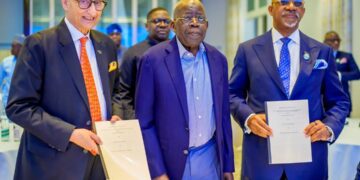





The Chairman of the Ogun State Teaching Service Commission, Apostle Biodun Sanyaolu, has defended the recent redistribution of public secondary school teachers across the state, saying the exercise was not punitive but carefully designed to promote fairness and correct long standing staffing imbalances.
Sanyaolu spoke on Wednesday during an exclusive virtual interview on Frontier, a socio economic and political programme aired on Eagle 102.5 FM, Ilese, Ijebu, amid complaints from some teachers who were posted to schools far from their homes.
He stated clearly that the exercise was neither a mass transfer nor targeted at any individual.
According to him, the decision was based on objective findings after the commission reviewed teacher deployment across Ogun State.
“Let me say very loud and clear that this exercise is not a mass transfer and it is not a punitive measure to anybody. It is not targeted at any individual at all,” Sanyaolu said.
Explaining the reason for the redistribution, the TESCOM chairman said the commission discovered serious disparities in staffing levels across the state’s 517 public secondary schools shortly after he assumed office.
He said many complaints were received from communities, school principals and other stakeholders about the lack of teachers, especially in semi urban and rural schools, prompting a comprehensive assessment of teacher distribution.
According to Sanyaolu, the findings revealed that while some schools were critically understaffed, others were heavily overstaffed, particularly in urban centres.
“We have many schools that are supposed to have between 30 and 40 teachers, but at the moment they have 87, some 92. That is about 200 to 300 per cent overstaffing,” he said.
He added that subject imbalance was also a major concern, noting that some schools had excess teachers in certain subjects while others had none.
“We found schools that are supposed to have three English teachers having six, eight or even nine, while at the same time there are schools without a single English teacher,” he said.
Sanyaolu also faulted the long stay of some teachers in one school, saying it affected productivity and innovation.
“We found teachers who have been in one school for 10 years, 15 years, even 20 years. When you are too long in a place, you run out of ideas and diminution sets in,” he said.
He further pointed to workload imbalance, explaining that some teachers in urban areas handled as few as four periods in a week, while their counterparts in other locations took up to 40 periods weekly.
Addressing resistance from some teachers, the TESCOM chairman said the reluctance to move was largely driven by comfort rather than genuine hardship.
“Some teachers don’t want to leave their comfort zone. Some want the school to be right inside their sitting room,” he said, questioning whether such expectations were part of their employment terms.
On reports of tension with the Academic Staff Union of Secondary Schools, ASUSS, Sanyaolu said the issues had been resolved through dialogue. He disclosed that a review panel had been set up to address special cases involving medical conditions, family challenges and retirement considerations.
Out of the 3,401 teachers affected by the exercise, he said less than 10 per cent submitted appeals.
Speaking on welfare, Sanyaolu said Ogun State teachers enjoyed better incentives than many of their counterparts. He noted that teachers receive an extra 15 per cent of their basic salary, while non teaching staff receive 10 per cent above standard civil service pay.
He also confirmed that rural allowance had been increased from ₦1,000 to ₦5,000 monthly, with a proposal before the governor to raise it to ₦10,000. In addition, he said agricultural support programmes had been introduced to help rural teachers generate extra income.
Sanyaolu dismissed allegations that the postings were manipulated, stressing that the process was handled by a 25 member committee, not by him personally. He explained that teachers were first moved within their local governments or divisions, and only transferred outside those areas when absolutely necessary.
On the impact of the exercise, he expressed confidence that it would improve teaching and learning across the state, insisting that quality education should not be limited to a few urban schools.
“Schools that had no English teachers now have them. Schools that had five teachers now have ten. Quality education must be spread across Ogun State,” he said.
He also warned that the era of cash and influence driven transfers was over, adding that no posting would be altered without the approval of the full committee.
Listeners who called into the programme expressed mixed reactions, with some urging government to consider teachers’ personal lives, while others supported the redistribution as necessary.
Responding, Sanyaolu maintained that mobility was a standard requirement in public service and essential for equity in education delivery.