
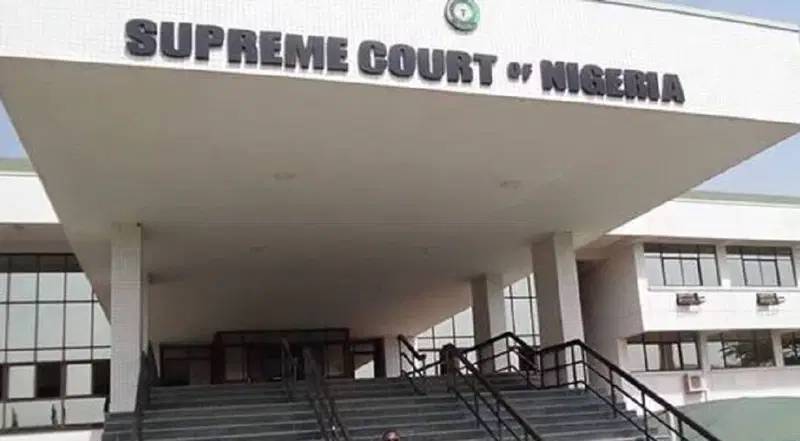
The Supreme Court has affirmed that the President has the constitutional power to declare a state of emergency in any state to prevent a breakdown of law and order or a slide into chaos.
The apex court also ruled that during such periods, the President may suspend elected officials, provided the suspension is within a limited timeframe.
In a split decision of six to one, Justice Mohammed Idris, delivering the lead majority judgment, held that Section 305 of the Constitution grants the President the discretion to take extraordinary measures to restore normalcy when an emergency is declared.
“Section 305 does not specify the nature of the extraordinary measures, giving the President the authority to determine the necessary actions to maintain order,” Justice Idris stated.
The ruling arose from a suit filed by Adamawa State and ten other Peoples Democratic Party-led states challenging the propriety of the emergency declared by President Tinubu in Rivers State, which saw the suspension of Governor Siminalayi Fubara and other elected officials for six months.
Justice Idris, while upholding preliminary objections raised by the Attorney General of the Federation and the National Assembly, noted that the plaintiffs failed to establish any cause of action capable of invoking the original jurisdiction of the Supreme Court.
The suit was struck out for lack of jurisdiction but was also determined on its merits and dismissed.
Dissenting, Justice Obande Ogbuinya argued that although the President could declare a state of emergency, such powers could not be used to suspend elected state officials, including governors, deputy governors, and members of the National Assembly.