



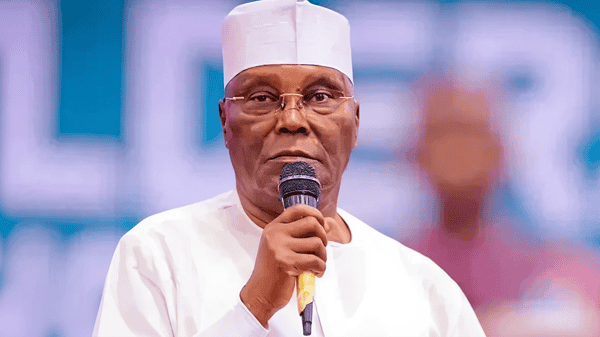
The camp of former Vice President Atiku Abubakar has accused President Bola Tinubu of removing fuel subsidy from poor Nigerians while granting waivers to his friends and multinational companies, saying petrol could sell for about ₦500 per litre under its proposed production-based subsidy model.
The accusation was made on Monday by Senior Special Assistant on Public Communication to former Vice President Atiku Abubakar, Phrank Shaibu, during an exclusive interview on Frontline, a current affairs programme on Eagle 102.5 FM, Ilese-Ijebu, Ogun State.
Shaibu said the proposed subsidy model would move government intervention away from imported petroleum products and middlemen and instead support domestic refineries based on their production.
He alleged that the Tinubu administration had claimed to have removed fuel subsidy while simultaneously using public resources to provide waivers worth 34 trillion Naira and incentives to selected businesses.
“Tinubu claims he has removed fuel subsidy. This same man is using the same money to give waiver to his friends and multinational companies. 34 trillion Naira represents over 61% of the entire budget of the Federal Republic of Nigeria. Who did Tinubu give 34 trillion Naira waiver to? What it means is that he has been robbing Peter to pay Paul. He cannot rob poor Nigerians and carry the money and give waivers to his friends because they are white men.”
“Someone that after a bowl of Amala and Gbegiri, climbed the podium at Eagle Square on May 29, 2023, and announced subsidy is gone in three weeks. He did that without a plan.”
Shaibu further argued that the resources could instead be deployed to support local refineries and bring down the cost of petrol.He said Atiku’s proposed model would tie subsidy directly to crude supplied to qualifying domestic refineries rather than to oil marketers.
“Under the Atiku’s proposal, the subsidy follows the barrel, not the marketer. Our support is tied directly to crude supply to qualifying domestic refiners.”
Shaibu said the proposed arrangement would require every barrel supplied to participating refineries to be tracked, with the benefit reflected in the final pump price.
“With every barrel tracked and the benefit required to reflect in the pump price. The benefit will be tied to the pump price.”
He further claimed that if the resources represented by the alleged ₦34 trillion import waivers were redirected to domestic refining, the price of petrol could be reduced significantly.
“Do you know that if we give that import waiver of 34 trillion to Dangote, my dear brother Atiku would force down the price of petrol to 500 Naira for the next five years. Calculate it. It’s simple arithmetic. About four and a half years to five years.”
Shaibu argued that the Tinubu administration’s claim of benefiting financially from the removal of petrol subsidy was misleading, insisting that the policy had merely shifted the burden of subsidy removal onto ordinary Nigerians while worsening the cost of living.
“Tinubu removed subsidy only from the poor. He announced it, and immediately after the announcement, prices of everything went up by over 500 to 1,000, 2,000 percent.”
“They have made so much money from subsidy removal. And Atiku is saying, no this man has not removed subsidy in the first place,” he said.
“Why would you take money from the poor and hand the money over to your friends and associates in the name of import waivers?” he asked.
Using Dangote Refinery as an example, Shaibu claimed that government could redirect resources currently spent on incentives and waivers towards domestic refining.
“Do you know that if we give import waiver of 34 trillion to Dangote, Atiku would force down the price of petrol to 500 Naira for the next five years, instead of the 1,000 and something Naira we pay per litre,”he said.
According to him, Atiku’s proposed model would direct government support to domestic refineries rather than independent oil marketers.
He explained that the proposed arrangement would tie government support directly to crude supplied to qualifying domestic refineries, with the quantity of crude supplied and the resulting benefits subject to monitoring.
“The subsidy follows the barrel, not the marketer with every barrel tracked and the benefit required to reflect in the pump price,” he said.
He said the proposed system would include mechanisms to prevent refiners from diverting subsidised crude or petroleum products.
According to him, the government would track crude supplied to refineries and ensure that the benefit of the subsidy was reflected in the final pump price. He also said an Atiku administration would seek legislative backing for the proposed system and introduce mechanisms that would make the process more transparent.
Shaibu further proposed a mobile application through which Nigerians could monitor crude allocations and refinery output.
“The moment crude is given to a particular refinery; this is the quantity of crude given to this refinery. You can track it from production until the finished products are delivered to the people,” he said.
He said the application would enable Nigerians to independently monitor the movement of crude from production through refining to distribution.
Shaibu said the objective was to ensure that whatever support government provided would translate directly into lower petrol prices for consumers rather than becoming another channel for rent-seeking.
He argued that the model would also encourage investment in local refining and gradually reduce Nigeria’s dependence on imported petroleum products. He said the proposed price reduction could last for roughly four and a half to five years under the model being advocated by Atiku.
According to him, government should use incentives to stimulate domestic production rather than provide benefits to importers.
Shaibu said Atiku’s approach would be to encourage domestic refineries to increase production and create competition within the downstream petroleum sector.
He argued that increased domestic refining would eventually create conditions for a more stable petrol price.
He added that competition would eventually lead to greater price stability and reduce the need for government intervention.
“The moment the price becomes stable, there will be no need,” he said.
He stressed that Atiku’s proposed subsidy was not intended to become a permanent feature of the Nigerian economy.
“Subsidy is all over the world. It’s not designed to be there forever but you must create stability and when there is stability and the people can now afford, what becomes affordability, it is about purchasing power,” Shaibu said.
He said the ultimate objective was to move from subsidy to a functioning domestic refining industry where competition and supply would keep prices affordable.
He believes the effect of lower energy costs would extend beyond petrol stations into transportation, agriculture, manufacturing and food prices.
Shaibu said the cost of fuel was connected to virtually every part of the Nigerian economy because transporters, farmers, manufacturers and distributors all depend on energy.
He illustrated the proposed approach with rice production, arguing that lower fuel and diesel costs would reduce the cost of moving rice from farms to consumers.
He said farmers would receive support to increase production, while cheaper energy would reduce milling and transportation costs.
According to him, the government would also provide security to enable farmers to return to their farms. He argued that increased agricultural production, combined with cheaper transportation and processing, would ultimately lower food prices.
“Atiku is simply saying the moment we look at these figures and we say we want to sell rice at 20,000 Naira, the money will be budgeted for. When the money is budgeted for, the price of rice is reduced to that amount of money, 20,000 Naira per bag. We support all the local farmers in Nigeria to produce more rice by providing everything they need, including security, so that the farmers can return to their farmlands. And because the price of fuel is low and has been reduced, when the rice farmer in Kebbi is done, he sends his rice to the rice millers. The rice millers, because the cost of diesel has reduced, will mill the rice at a reduced cost, other than what it used to be. Now the transporters, after milling the rice, will now send the rice to mile 12 market in Lagos and other markets across Nigeria at that reduced cost, because the fuel economy propels every other economy in Nigeria. That is the model Atiku is talking about,” he explained.
Shaibu noted that the same principle could apply to petroleum refining.
He noted that Dangote Refinery was not the only domestic refinery that could benefit from the proposed model, pointing to modular refineries and the proposed BOA Refinery.
“Dangote Refinery is not the only one who owns a refinery in Nigeria,” he said.
He added that BOA Refinery was expected, according to him, to become operational in the first quarter of 2027.
“BOA has been given license by this government and by the time Atiku is taking over in May 2027, BOA Refinery will be up and working. Dangote Refinery, for instance, produces about 45 million barrels of oil per day. Now, at that cost, with that number, if BOA joins and all the modular refineries are up and working, of course, we’ll be able to service Nigeria effectively” he assured
Shaibu defended the change in position by arguing that economic circumstances had changed since the 2023 election campaign.
He said Atiku had previously advocated gradual subsidy removal alongside production support but argued that the circumstances created by Tinubu’s immediate subsidy removal required a different approach.
“Other things being equal. That is a Latin aphorism. That means other things being equal. Are other things still equal? No, sir. Other things are no longer equal,” he said.
He insisted that the proposed subsidy was therefore not merely an electoral promise aimed at winning votes.
Shaibu also rejected the suggestion that Atiku’s proposal amounted to a return to the old subsidy regime.
He said the fundamental difference was that the proposed support would be attached to domestic production rather than imported products and marketers.
“The subsidy follows the barrel, not the marketer,” he reiterated.
The proposal comes after Atiku recently announced plans to restore fuel subsidy if elected president, a position that has generated criticism from supporters of the Tinubu administration and renewed debate over the economic consequences of subsidy removal.