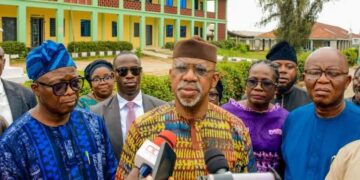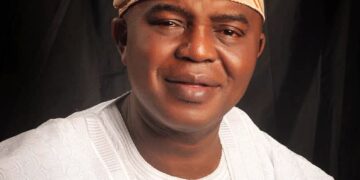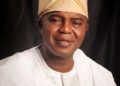




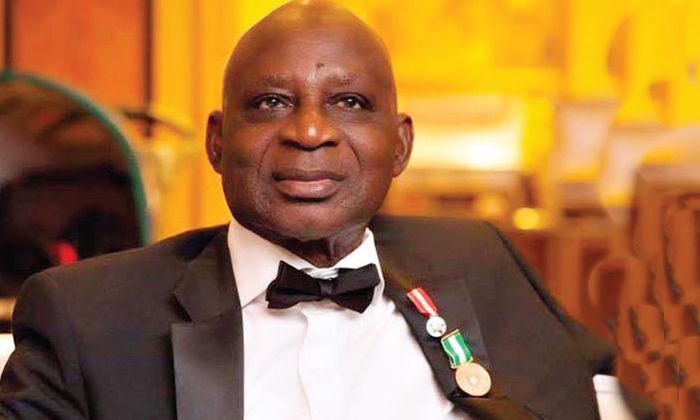
A former senator who represented Ogun Central Senatorial District, Femi Okurounmu, has criticised Nigeria’s 1999 Constitution, alleging that it structurally favours the northern region and continues to shape governance outcomes in ways that undermine equity and national stability.
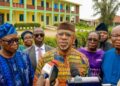
Speaking during an interview on Frontline, a current affairs programme on Eagle 102.5 FM, Ilese-Ijebu, Ogun State, on Wednesday, the elder statesman said the foundation of Nigeria’s democracy remains flawed, warning that meaningful development may remain elusive without urgent structural reforms.
Okurounmu argued that the existing constitutional framework has created an imbalance in political power distribution, which he said affects decision-making at the highest levels of government.
“I will let you know that the problem is much more complicated than that. The 1999 Constitution has more or less tilted all the structures of governance in favour of the North. The North has infiltrated the central government so much that whoever is the president does not matter,” he said.
He added that the implications of such imbalance are far-reaching in a diverse country like Nigeria, where fairness in representation is essential for unity.
The former lawmaker also described the 1999 Constitution as lacking democratic legitimacy, tracing its origin to the regime of late Head of State, Sani Abacha. According to him, the document was imposed on Nigerians without adequate consultation.
“The 1999 Constitution was simply a decree which Abacha brought out and turned into a constitution for us. It was not even made known to the public until after the elections,” he said.
Okurounmu further noted that many provisions in the 1999 Constitution mirror those of the 1979 Constitution, which he claimed was also engineered without sufficient equity.
“And a lot of the provisions are very similar to that of the 1979 Constitution… most of the provisions are very unequitable insofar as governance in Nigeria is concerned. The 1999 Constitution virtually gives veto power to the North over how Nigeria will be governed,” he added.
He explained that the numerical advantage of the northern region, in terms of states and local government areas, translates into greater representation in the National Assembly.
“The North has advantages in the number of states, which means it also has advantages in the number of senators. It also has an overwhelming advantage in the House of Representatives. No decision can be taken unless the North is agreeable to it,” he said.
Okurounmu warned that such dominance fuels feelings of marginalisation among other regions and could deepen existing divisions.
Reflecting on past reform efforts, the Afenifere chieftain expressed disappointment over the failure to implement recommendations from the 2014 National Conference, which he said could have improved governance and ensured fairness.
“That conference came up with recommendations that, if implemented, would have brought some level of fairness and efficiency into the system. Unfortunately, those recommendations were ignored,” he stated.
He also argued that the current structure limits the effectiveness of elected leaders, including the president, stressing that governance outcomes are largely determined by the system rather than individuals.
“Whoever is the president under this constitution does not really matter as much as people think, because the structure itself controls governance,” he said.
On insecurity, Okurounmu linked the persistent challenges to deeper systemic issues within Nigeria’s political framework, noting that lasting solutions must go beyond military responses.
“When you look at insecurity in Nigeria today, there are deeper systemic issues connected to how the country is structured and governed. Until we address those problems, it will be difficult to achieve lasting peace,” he said.
He also addressed the agitation for an Igbo nation, saying the demand for self-determination is not wrong, but criticised the use of force by some groups.
“The agitation itself is not bad; it’s the way they are going about it that is not good. If ethnic nationalities meet and decide peacefully on their future, why not?” he said.
Okurounmu called for a fresh national dialogue involving all ethnic nationalities to determine a more balanced and sustainable framework for Nigeria.
“The country is becoming unsustainable as one nation if we continue with this structure. What we need now is a sincere and honest conversation that ensures peace, fairness and mutual respect,” he warned.
He urged political leaders to prioritise equity and national unity, cautioning that failure to address structural imbalances could have long-term consequences for the country’s stability.