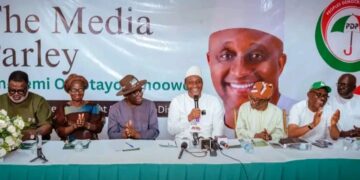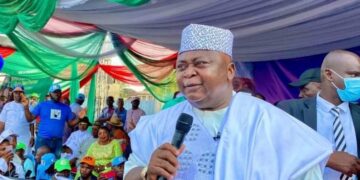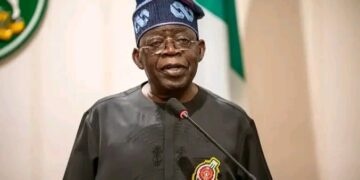




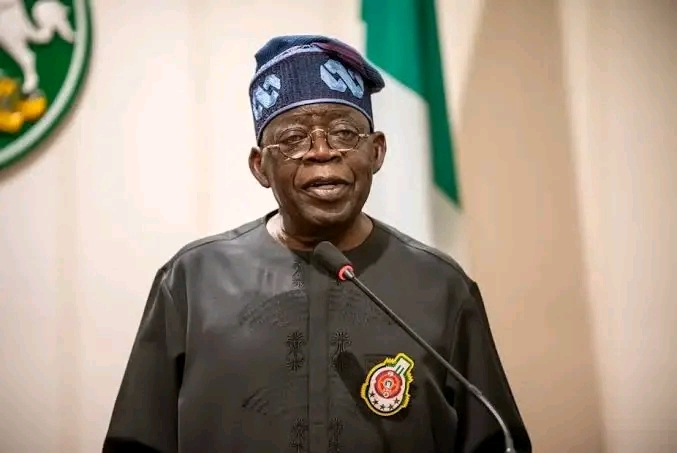
A chieftain of the Nigeria Democratic Congress, NDC, Ladipo Johnson, has rejected the description of President Bola Tinubu’s administration as progressive, arguing that the government’s economic policies have failed to adequately address the welfare of Nigerians.
Johnson, who is also the NDC senatorial candidate for Lagos Central, stated this on Tuesday while speaking on Frontline, a current affairs programme on Eagle 102.5 FM, Ilese-Ijebu.
He argued that being progressive, in political terms, should involve policies that are more welfare-oriented and aimed at improving the living conditions of citizens.
“Would you call President Tinubu’s administration a progressive administration? Progressive, in political terms, indicates when someone is slightly left of center. That means, left of center should be more welfaristic in nature,” he stated.
The NDC chieftain further questioned the level of government support available to struggling Nigerians, saying the administration’s emphasis on revenue generation does not necessarily amount to progressive governance.
“How many of the Nigerian citizens especially those who are struggling, will tell you that, so-so-so is subsidized for them.”
According to Johnson, such an approach is closer to a right-of-centre government than a progressive administration.
Rather, you have someone who his track record has shown you, over time, since he was in Lagos, that seems to believe that when government is raking in revenue, that means he’s performing. So you see them always going for government revenue,” he added.
government. You would expect that from a PDP government.”
Johnson also compared the present administration with the policies and records of other political leaders, particularly in education and healthcare.
He said, “They are saying that they are progressive but go to Kano, for instance or go and look at Mr. Peter Obi’s record. See what they did in healthcare. Look at the education. The scholarship schemes that they ran.”
The NDC chieftain also questioned whether the increase in the minimum wage, which he acknowledged as being substantial on paper, had translated into improved purchasing power for workers.
He said, “We could have increased the minimum wage by over 100%. On paper, sounds fantastic. What is the value of that increase in Naira terms and in the value of what it can purchase? If you increase minimum wage, you’re increasing inflation.”
He criticised what he described as continued government spending while subsidies on fuel and electricity had been removed.
“The other things you should be doing, you’re not doing. Government is still spending. National Assembly is spending. Even the judiciary. That is the problem. You take away fuel subsidy. You take away electricity subsidy. Which other one have they not taken away? The government is not there so that a retired commissioner, or governor, or senator, or whatever, can be changing jeeps, and changing four-wheel drives, or what have you” he lamented.
Johnson also questioned whether initiatives such as the Nigerian Education Loan Fund, NELFUND, would have their desired impact without corresponding efforts to create employment opportunities for graduates.
“You say you are giving people money for quality education, whatever. When you educate them, how easy is it for them to get any jobs? Is the economy moving?” When these people come out, how is it easy for them to get employed? Is education making them employable? Are we still doing theoretical education in this day and age? These are the questions we must be looking at.”
The NDC chieftain explained that Nigeria needs to properly balance education, skills development and employment, recalling an example from Spain where, according to him, the country ensured that technical workers were produced alongside engineers.
He said, “Are we still doing theoretical education in this day and age? These are the questions we must be looking at. In Spain, I think in maybe the 90s, for every engineer they produced, they made sure they produced 20 technicians. So we have to know what we’re doing”
On the wider question of whether the Tinubu administration has delivered economically, Johnson said government policies should be judged by the results they produce rather than by the policies themselves.
“You can have a lot of initiatives, a lot of activities. The governors can be happy. They’ll be happy if they have more money to spend. At the end of the day, the buck stops at the president’s table. These policies are meant to achieve something. Don’t just do policy for the sake of policy.” he said.
He said Nigerians would ultimately determine whether the administration’s policies had worked when they vote in 2027.
Johnson also criticised the removal of fuel subsidy and the floating of the naira, questioning whether the two policies had been properly balanced.
“How can you remove subsidy and at the same time float your naira? They are still reeling from that. They are trying to recover.”
The NDC chieftain further criticised the decline in the value of the naira, saying, “You take naira from 400 and crash it to 1,900 and someone is telling me that is the real value…That we are now back on 1,380 to the dollar and that is the real value”