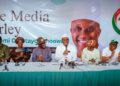





A chieftain of the Labour Party, Dr Abayomi Arabambi, has challenged former presidential candidate of the party, Peter Obi, to provide evidence to substantiate his claim that he won the 2023 presidential election.
Arabambi made the call on Thursday while speaking on Frontline, a current affairs programme on Eagle 102.5 FM, Ilese-Ijebu, Ogun State, where he argued that claims of electoral victory must be backed by credible and admissible evidence, particularly when such claims have been subjected to judicial scrutiny.
His reaction followed a recent interview granted by Obi to the BBC, in which the former Anambra State governor reportedly maintained that he won the 2023 presidential election, while acknowledging that he had no evidence to substantiate the claim.
According to Arabambi, an election petition is determined by the grounds contained in the petition and the evidence presented before the court, rather than political arguments or personal convictions expressed outside the courtroom.
“You cannot just say you won an election; you must be able to prove it with evidence,” Arabambi said.
He maintained that documents tendered before a court must be properly established and authenticated through the appropriate authorities, stressing that political popularity or public sentiment could not replace the evidentiary requirements of an election petition.
The Labour Party chieftain also argued that the outcome of an election case was not determined by the amount of money spent on litigation, but by the quality and credibility of the evidence presented before the court.
“The court is not going to determine an election based on how much money you spend on the petition, but based on the evidence before it,” he said.
The 2023 presidential election was won by Bola Tinubu of the All Progressives Congress with 8,794,726 votes, while Atiku Abubakar of the Peoples Democratic Party polled 6,984,520 votes. Obi came third with 6,101,533 votes, according to figures declared by the Independent National Electoral Commission.
Obi and the Labour Party challenged the outcome at the Presidential Election Petitions Court, while Atiku and the PDP also challenged Tinubu’s victory. The petitions were dismissed in September 2023, while the Supreme Court subsequently affirmed Tinubu’s election in October of the same year.
Arabambi said the legal outcome of the 2023 election dispute made the issue of evidence particularly important, arguing that anyone challenging an election must demonstrate how the evidence before the court establishes the allegations contained in the petition.
He also criticised the Labour Party’s preparedness for the 2023 election, particularly its deployment of polling agents and documentation of results at polling units.
According to him, the party did not have agents in about 56,000 of the 176,000 polling units across the country. He further claimed that the party had only 4,859 coalition agents out of the 9,551 required.
Arabambi questioned how the party could sufficiently establish results from polling units where it had no representatives to participate in the process.
“How do you establish results from polling units where you had no agents to participate in and authenticate the process?” he asked.
He said the experience should serve as a lesson to political parties ahead of the 2027 general elections, urging them to strengthen their polling-unit structures, properly train their agents and establish effective systems for documenting and collating results.
On the controversy surrounding Obi’s academic credentials, Arabambi said his concern was to ensure that relevant documents were subjected to verification through the judicial process.
“I went to court. I only asked, where is the documentation? They have not produced anything. The registrar will come to court,” he said.
The issue generated reactions from callers, with one listener from Ijebu-Ode questioning Arabambi’s motivation for pursuing the certificate matter and asking why similar controversies involving other political leaders had not attracted the same attention.
Another caller accused Arabambi of being driven by personal grievances against Obi. Arabambi, however, rejected the allegation, insisting that his position was based on principle, due process and the need for political personalities to remain subject to scrutiny.
He further called on the Labour Party to address its internal weaknesses and improve its preparations for the 2027 elections, particularly by ensuring adequate representation at polling units and establishing a reliable system for documenting results from voting through collation.