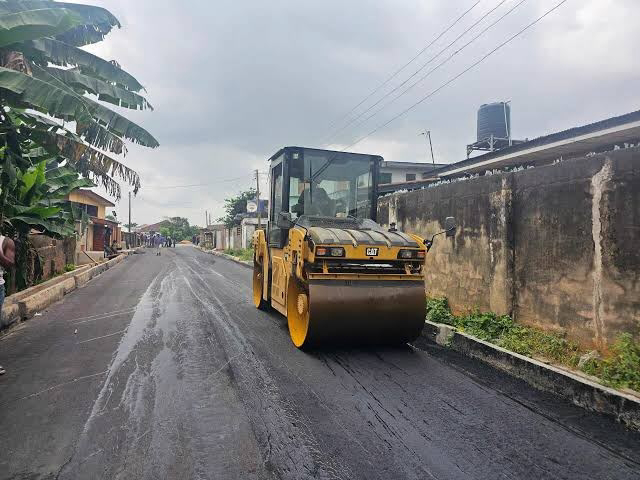






How more than 1,700 kilometres of roads are reshaping mobility, opening up rural communities, strengthening industrial corridors and redefining infrastructure development across Ogun State
By Kayode Akinmade
Infrastructure development is one of the most visible measures of governance because its impact is felt in the everyday lives of citizens. A good road connects communities, shortens travel time, facilitates commerce, improves access to healthcare and education, enhances security and creates opportunities for economic growth. Beyond the convenience of transportation, roads are critical instruments of social integration and economic transformation.
For Ogun State, whose strategic location places it at the intersection of major commercial and industrial activities in Nigeria, road infrastructure is particularly important. Sharing boundaries with Lagos, the country’s commercial nerve centre, and serving as a major gateway to the Southwest and other parts of the country, Ogun requires an extensive and efficient road network to sustain its expanding population, growing industrial base and increasing commercial activities.
It was against this background that Governor Dapo Abiodun placed infrastructure development at the centre of his administration’s development agenda upon assuming office in May 2019.
The task before the administration was enormous. Years of inadequate maintenance, increasing population pressure, rapid urbanisation and the expansion of commercial activities had left several roads across the state in deplorable conditions. Many communities, particularly in rural and semi-urban areas, had endured prolonged difficulties accessing neighbouring towns, markets, schools, healthcare facilities and other essential services.
For some communities, travelling a few kilometres could become an exhausting experience, especially during the rainy season. Farmers struggled to move their produce to markets, traders incurred additional transportation costs, while residents of emerging urban settlements faced the daily frustration of deteriorating roads.
The Abiodun administration therefore adopted a statewide approach to road development, recognising that infrastructure should not be concentrated in a few urban centres but distributed across the state’s 20 local government areas.
More than seven years into the administration, the scale of the intervention is reflected in the approximately 1,700 kilometres of roads constructed or rehabilitated across the state since 2019. The government has set a target of delivering 2,000 kilometres before the end of its tenure.
The figures represent an extensive infrastructure programme involving the construction of new roads, reconstruction of failed roads, rehabilitation of existing routes and the provision of supporting infrastructure.
But beyond the kilometres, the more important story is what these interventions mean for communities and the state’s economy.
CONNECTING COMMUNITIES, OPENING UP OPPORTUNITIES
One of the defining features of the administration’s road programme is its attention to communities that have historically struggled with poor road access.
In Ogun West, the reconstruction of the Ilaro–Owode Road has strengthened connectivity across the Yewa axis, while the completion of the Odo-Afa and Afon bridges along the Imeko-Afon corridor has addressed critical transportation challenges in rural communities.
Other interventions, including the General Hospital–Aferiku Road and Oke Erinja–Erinja Road Phase 2, have improved access to communities in Yewa South.
These projects demonstrate the importance of infrastructure beyond major urban centres. For farming communities, an accessible road can determine how quickly agricultural produce reaches markets, how much farmers spend on transportation and how much value they ultimately derive from their investments.
In a state with considerable agricultural potential, connecting farming communities to markets is central to food security, rural development and poverty reduction.
The same development philosophy is evident in other parts of the state.
In Obafemi-Owode Local Government, the Mowe–Ofada and Siun–Owode roads have improved access within rapidly developing communities. The Siun–Owode–Ofada corridor is particularly significant because of its connection to economic activities and settlements along the Lagos–Ibadan Expressway.
In Ifo Local Government, the rehabilitation of roads such as Akute–Gbero–Isase, Alhaji Kosoko, Ajuwon–Akute and other adjoining routes has addressed long-standing transportation difficulties in communities experiencing increasing population growth and urban expansion.
For residents of these communities, road infrastructure is not an abstract government achievement. It is about spending less time in traffic, reducing vehicle maintenance costs, improving access to workplaces and making daily commercial activities less stressful.
REBUILDING THE INDUSTRIAL CORRIDORS
Perhaps nowhere is the economic significance of road infrastructure more evident than in Ogun’s industrial belt.
Ogun is home to several manufacturing clusters, industrial estates and commercial centres, many of which depend on efficient road networks for the movement of raw materials, finished products, workers and other logistics.
The reconstruction of the Ota–Abeokuta Road, a major 70-kilometre corridor, is one of the significant interventions in this regard. The road serves communities and commercial establishments across the Ado-Odo/Ota and Abeokuta axes.
Similarly, road projects around Lusada, Alapoti, Igbesa and other industrial communities are important to the continued expansion of manufacturing activities in Ogun West.
The Lusada–Alapoti Road and other adjoining routes are particularly relevant to industrial development in the Agbara–Ota axis, where manufacturing companies depend on reliable transportation infrastructure.
The administration’s road programme also complements its broader efforts to attract investments and position Ogun as a preferred destination for industrial and commercial enterprises.
The relationship between roads and investment is straightforward. Investors require access to industrial locations, efficient movement of goods, dependable logistics and connectivity to major markets. Without these, the cost of doing business increases and the attractiveness of an investment destination diminishes.
This explains why road infrastructure remains an essential component of the administration’s economic development strategy.
The emerging industrial developments around the Gateway International Airport, the proposed Gateway Deep Sea Port and the Blue Marine Economic Zone further underscore the importance of expanding and improving road connectivity across the state.
These projects require an integrated transportation network capable of supporting industrial production, maritime activities, warehousing, distribution and international trade.
URBAN RENEWAL AND THE GROWING POPULATION
Ogun’s proximity to Lagos has created enormous demographic and economic opportunities, but it has also placed considerable pressure on existing infrastructure.
Communities such as Mowe, Ibafo, Magboro, Arepo, Akute, Ajuwon, Alagbole, Ijoko and Ota have experienced rapid population growth as more people seek residential accommodation outside Lagos.
This expansion has increased demand for roads, drainage, public transportation and other essential infrastructure.
The administration’s interventions in these areas are therefore significant to the management of urban growth.
The reconstruction of Magboro Road, Alagbole–Ajuwon Road, Akute–Ajuwon Road and other connecting routes reflects the government’s response to the transportation challenges associated with expanding settlements.
These projects are expected to improve connectivity within the communities and strengthen their links with Lagos and other parts of Ogun State.
In Abeokuta, the state capital, several road projects have also been undertaken to improve mobility and enhance the urban environment.
Similar interventions across Sagamu, Ijebu-Ode, Ikenne and other major towns form part of the wider effort to improve road infrastructure throughout the state.
FROM ROAD CONSTRUCTION TO ECONOMIC TRANSFORMATION
The significance of the road revolution should ultimately be measured by its contribution to economic and social development.
A road connecting a rural community to a major market is an economic asset. A road providing access to a hospital can make a difference in emergency situations. A road linking an industrial estate to a major highway can improve productivity and reduce logistics costs.
These are the practical outcomes that give meaning to infrastructure investment.
The Abiodun administration has consistently argued that its infrastructure policy is designed to democratise development by ensuring that communities across the three senatorial districts benefit from government interventions.
With approximately 1,700 kilometres of roads constructed or rehabilitated since 2019, the administration continues to pursue its 2,000-kilometre target.
The government has also incorporated inherited road projects into its programme, demonstrating that infrastructure development requires continuity and sustained investment beyond political and administrative transitions.
Nevertheless, the scale of the remaining infrastructure needs must not be overlooked. Several communities continue to demand improved roads, while increasing traffic, population growth and heavy-duty industrial vehicles place additional pressure on existing infrastructure.
The challenge, therefore, is to sustain the pace of construction, ensure quality delivery, maintain completed roads and prioritise projects according to their economic and social importance.
Road construction must also be accompanied by adequate drainage systems, proper engineering standards and effective maintenance arrangements to ensure that public investments deliver lasting value.
THE ROAD AHEAD
As Ogun State moves towards the final phase of the Abiodun administration, the ambition of delivering at least 2,000 kilometres of roads provides a measurable benchmark for assessing the government’s infrastructure programme.
But the broader significance of the initiative extends beyond the numbers.
From the rural communities of Yewa to the industrial clusters of Agbara and Ota, from the expanding settlements along the Lagos–Ibadan Expressway to the commercial centres of Ijebu-Ode and Sagamu, road infrastructure is an important part of the state’s evolving development story.
The objective is to create a connected Ogun where communities are not isolated by poor roads, farmers can move their produce more efficiently, businesses can operate with reduced logistical constraints and residents can enjoy improved access to opportunities.
The journey is far from complete. The demands of a rapidly expanding state will continue to require investment, planning and sustained attention to infrastructure.
Yet the approximately 1,700 kilometres of roads already constructed or rehabilitated provide a substantial basis for examining the administration’s road development record.
Ultimately, the true measure of a road revolution is not simply the number of kilometres delivered. It is the number of communities connected, the economic activities stimulated, the transportation difficulties reduced and the opportunities created for the people.
That is the larger development story behind Abiodun’s road infrastructure programme: moving Ogun from isolated communities towards an increasingly connected network of economic corridors.