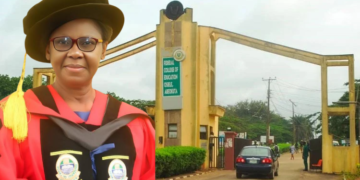





By Adejola Adeyemi Crown
A renowned music scholar, Dr. Adetutu Olorunsogo, has raised concerns over the dominance of Western music in Nigeria’s educational curriculum, describing it as a form of “cultural brainwashing” that has alienated young Nigerians from their indigenous musical heritage.
Delivering the 5th Lecture Series organized by the School of Arts and Social Sciences, Federal College of Education, Abeokuta on Wednesday titled “Folksongs as Repository of Culture: An Appraisal,” Dr. Olorunsogo narrated her personal journey through Nigeria’s music education system, which she said systematically erased her connection to her cultural roots.
“I was musically acculturated and brainwashed into appreciation of western music while relegating the music of my forebears,” she declared before a gathering of academics, students, and cultural enthusiasts.
The scholar, who trained at the Federal Advanced Teachers’ College, Abeokuta, and the University of Lagos, recounted how her early exposure to lullabies, game songs, and folklore music in Ijebu-Igbo was gradually replaced by the works of Haydn, Handel, Mozart, Schubert, Bach, and Beethoven.
“The music education programme I was exposed to at FATC never inculcated any of the songs I was exposed to from my cultural background. The curriculum subjected us to perform the song repertoire of Western composers of all sorts,” she stated.
“This system of music education relegated our acquired music culture to the background and considered unfit for classroom study.”
Dr. Olorunsogo, however, noted that a reawakening came during the tenure of Professor Babs Fafunwa as Minister of Education from 1990 to 1992, when the curriculum was reviewed to include indigenous music content.
“Fafunwa rejuvenated the education curricula with brilliant strides in language and the arts; shifting focus to the revamp of African cultural heritage,” she said.
Drawing on the conceptual framework of ethnomusicologist Nettl (1983) and the challenge posed by Professor Meki Nzewi, the lecturer stressed that music education must be rooted in the learner’s cultural environment.
Citing Nzewi’s address at a Pan African Society for Musical Arts Education meeting in Botswana, she quoted: “Our task in scholarship and classroom education in Africa is to discern, unpack and deploy the humanity grammar and scientific logic of indigenous artistic conformations as foundation of knowledge as well as practice in contemporary education philosophy, theory and practice.”
Dr. Olorunsogo further referenced the International Folk Music Council’s 1954 definition of folk music as “the product of a musical tradition that has evolved through the process of oral transmission,” shaped by continuity, variation, and community selection.
She warned that Nigerian youths are now excessively exposed to foreign and mediocre music through the internet, leading to loss of cultural identity and moral decadence.
“Growing children are constantly being drained of songs indigenous to us. One of the main purposes of education is enculturation. It is expected that the products of an education system will develop in the understanding and practice of the culture of the immediate environment,” she asserted.
The don did not spare contemporary hip-hop and pop music, which she described as promoting waywardness, vulgarity, and unhealthy lifestyles among the youth.
“Most of these hip-hop musicians have mortgaged their personal identities and decency by what they term professional identities. It is very common to see a male hip-hop musician in braided hair, dreadlocks, ear rings, and culturing tattoos which this paper considers as unbecoming of decent appearance,” she observed.
She added that such musicians “drink, and smoke hemp to excess, are lazy, do not like to engage in physical labour… are improvident and foolish in the management of money.”
She further cited that products of formal music education “think of music in terms of the theories and qualities and properties rather than the communications it conveys to the masses, the message it conveys to the human minds and the way the music can be used to make people better.”
The lecture also highlighted the classification of music in Nigeria into four categories: Traditional Music, New Traditional (Folk music), Popular (Pop genres), and Classical Art/School Music.
Dr. Olorunsogo noted that traditional music forms such as Bolojo (Yewa), Apepe (Ijebu), Ogodo (Egba), and Apiiri (Ekiti) represent part of Nigeria’s identity and must be preserved.
She commended artistes like Fela Anikulapo Kuti, who utilized Yoruba folksongs in advancing Afrobeat, and Comfort Omoge, who gained international recognition through Ilaje indigenous music.
She also noted that prominent cultural ambassadors like Lagbaja, Beautiful Nubia, and Ara are not products of formal music education, raising questions about the effectiveness of the current system.
The scholar called for a deliberate policy to source, document, and teach folksongs at all levels of education, taking a cue from Eastern cultures such as Japan, China, and India.
“Japanese children grow up with culture codes, ethics and mores which they fully imbibed. Music educators can take a clue from this by going to the ‘drawing table’ to sift and sort all of the art and folk repertoire available as resource for teaching at pre and primary levels of our educational system,” she advised.
She called for a thorough needs-assessment to inculcate the right values and attitudes for the survival of the individual and society, and for the training of the mind in building valuable concepts and understanding of the world around us.
In his opening remarks, the Provost of the institution, Dr. Rafiu Soyele, who was represented by the Deputy Provost (Academics), Dr. J. B. Filani, congratulated the School of Arts and Social Sciences for successfully hosting the 5th edition of the lecture series.
He enjoined the School to extend the publicity of the lectures beyond the campus and bring audience from outside not just to enjoy the intellectual discourse but also to strengthen the idea of town and gown relationship.