



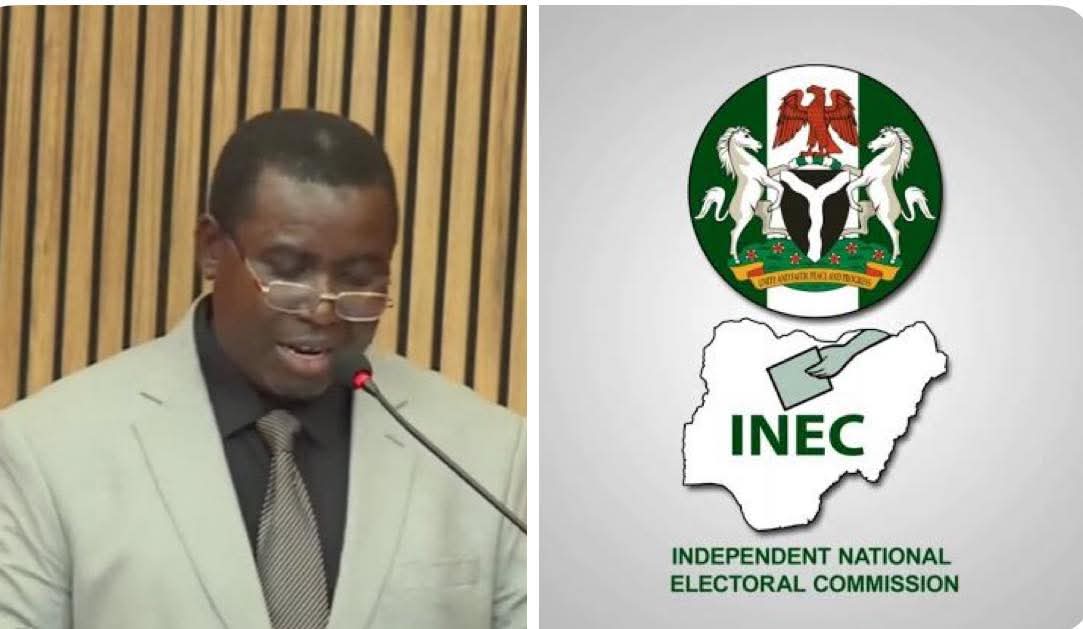
The Chairman of the Independent National Electoral Commission, Prof Joash Amupitan, has called for an urgent clean-up of the national voter register to strengthen credibility ahead of the 2027 general elections.
Amupitan said the register had not undergone a comprehensive review since 2011, adding that several names of deceased persons were still listed.
He spoke in Abuja during the Nigeria Civil Society Situation Room National Stakeholders Forum on Elections while giving an update on the Continuous Voter Registration exercise which ended on December 10.
He appealed to civil society groups to mobilise citizens for the claims and objections window that opens on December 15, saying it remains the only statutory opportunity for Nigerians to scrutinise entries on the register.
According to him, low participation in this stage had contributed to recurring problems.
Amupitan said, “I want to appeal to civil society and all stakeholders here to help mobilise citizens to take advantage of this window. Some of the challenges we face stem from low participation in this stage.
“For instance, during our review in Anambra, we assessed a register of 2.8 million voters, yet turnout suggested only a 20 per cent participation rate.”
“However, it is important to note that our voter register has not been comprehensively cleaned since 2011, meaning several names of deceased persons still appear.”
He added that a prominent Anambra figure, who died about 15 years ago, still appeared in the register.
He said this raised concerns about credibility and stressed that the claims and objections window was created to address such issues before the register is consolidated.
Giving updates on the concluded Phase One of the CVR, the INEC chairman said 2,685,725 applicants completed their registration between August 18 and December 10. He said the figure comprises 1,576,137 online registrations and 1,109,588 physical captures.
According to him, Osun recorded the highest number of new registrants with 208,357. It was followed by Kaduna, Plateau, Imo, Borno and Lagos.
Amupitan said Phase Two of the CVR would begin on January 5, 2026. He added that registration centres would be moved closer to wards and communities to overcome distance and access challenges recorded in the first phase.
On vote-buying, he said the commission had contacted security agencies for updates on those arrested in recent elections.
“We have written to the police, the EFCC and others to provide investigation reports on those arrested. INEC can only prosecute; we do not have powers to arrest,” he said.
Amupitan noted that the deployment of the Bimodal Voter Accreditation System and the INEC Result Viewing Portal had improved transparency, but poor network coverage continued to limit real-time uploads. He explained that BVAS can only perform optimally when network signals are stable.
He recalled a mock accreditation exercise in Anambra where several polling units recorded delays in BVAS uploads due to weak signals.
He added that INEC is in discussions with the Nigerian Communications Commission and mobile operators to address the problem, even though the commission does not control telecom infrastructure.
“Someone once asked what happens if a powerful politician convinces a service provider to switch off its service on election day. The truth is that we do not have control over these networks. These are the structural issues we must all confront,” he said.
Amupitan said the commission hopes to operate its own dedicated service infrastructure in the future.
He added that for now, citizens must take part in the claims and objections process to ensure the register reflects accurate voter information before the 2027 elections.