



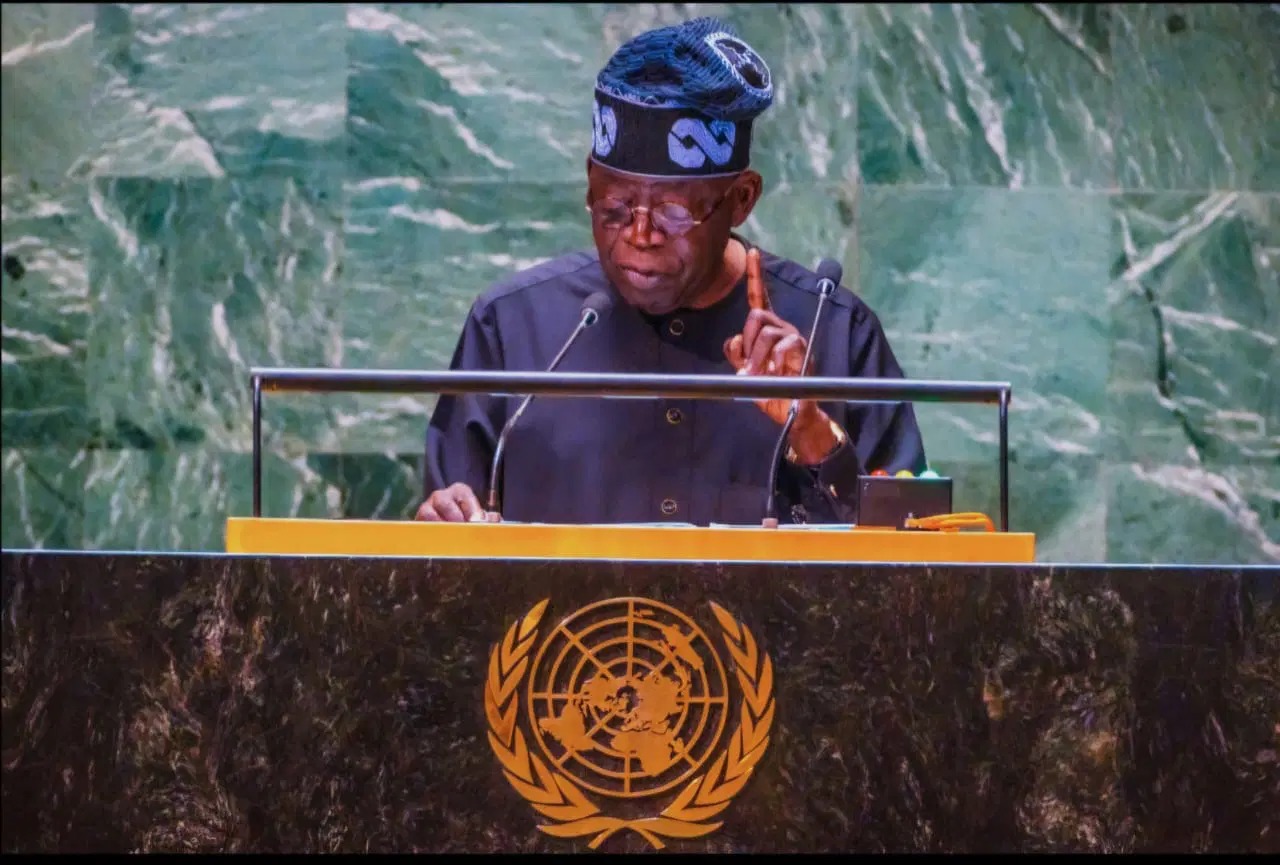
A Research Professor at the Nigerian Institute of International Affairs, NIIA, Prof. Femi Otubanjo, has said President Bola Tinubu’s absence from the ongoing 81st United Nations General Assembly, UNGA, should be viewed within the context of his annual leave, arguing that the gathering is “not so important” to require the President’s physical presence.
Otubanjo spoke on Tuesday while featuring on Frontline, a current affairs programme on Eagle 102.5 FM, Ilese-Ijebu, Ogun State, where he discussed Tinubu’s absence from the high-level UN meeting in New York.
The professor said public criticism of the President’s absence had failed to properly consider the circumstances surrounding his non-attendance, stressing that Nigeria’s national interest should remain the principal consideration.
“Majority of people talk without putting it in the proper context. Number one context is that President Bola Tinubu is on his annual leave and when he is on leave, he leaves the work of the office to other people to do it and UNGA is not so important,” he said.
He argued that attendance at the UN General Assembly should not be interpreted as an automatic measure of a country’s diplomatic effectiveness, adding that international relations involved broader diplomatic practices beyond physical presence at global gatherings.
According to him, the central issue should be whether Nigeria is adequately represented and whether its national interests are being advanced.
“The main thing is Nigeria’s national interest,” Otubanjo said.
His comments came as Vice President Kashim Shettima leads Nigeria’s delegation to the 81st UNGA in New York on the mandate of President Tinubu. The General Debate opened on September 22 and is scheduled to run through September 28.
Shettima arrived in New York on Monday and is expected to deliver Nigeria’s national statement, participate in high-level meetings and hold bilateral engagements with foreign leaders, international organisations and development partners.
Otubanjo maintained that the Vice President’s presence meant Nigeria was represented at a sufficiently high level.
“What is important, very important, is that we are represented. And we are represented at the highest level. That is the Vice President,” he said.
He further argued that there was no constitutional or diplomatic requirement for a president to personally attend every UN General Assembly session.
“It is not compulsory for a president to be at the United Nations General Assembly. What is important is representation, and this time we are represented by the number two man in the country,” he said.
Diplomacy not limited to physical meetings
The NIIA professor also questioned the assumption that a President’s physical presence at the UNGA necessarily translates into substantive diplomatic outcomes.
He said some encounters between heads of government during international gatherings could be brief and largely ceremonial rather than detailed working sessions.
“If you have a meeting with the president of France, and for five to ten minutes, it is that we enjoy, we are happy with our relationship, I hope we continue, we will continue. These are the kinds of complementary things that I’ve said at those meetings. They are not working meetings,” he said.
According to him, more substantive diplomatic discussions can take place through bilateral channels and other established mechanisms without requiring the physical presence of the President at every international event.
He cited the experience of the COVID-19 pandemic as evidence that modern technology had expanded the possibilities for remote official engagements.
“COVID taught all of us how to work remotely. The President is talking to his ambassadors and talking to businessmen outside Nigeria,” Otubanjo said.
Tinubu’s annual leave
The professor also urged Nigerians to consider the President’s annual leave when assessing his absence from the UNGA.
Tinubu left Nigeria on August 30 for London for what the Presidency described as a three-week annual leave before proceeding to Paris, where he held meetings with French President Emmanuel Macron and businessman Vincent Bollore.
The Presidency subsequently announced that the President had extended his working vacation by a few days and was expected to return to Nigeria at the weekend.
The Federal Government has maintained that Tinubu has remained in contact with developments in Nigeria and continued to direct the affairs of government while away. It also said he delegated Shettima to represent him at official engagements, including the UNGA.
Shettima’s current participation marks the third consecutive year he has represented Tinubu at the UN General Assembly, having done so at the 79th and 80th sessions in 2024 and 2025.
The repeated delegation has generated political debate, with former Vice President Atiku Abubakar questioning Tinubu’s absence from the annual gathering of world leaders.
The Federal Government, however, has maintained that Nigeria is fully represented and that Shettima is attending with the mandate of the President and the Federal Republic of Nigeria.
‘A nation’s domestic image determines its international image’
Beyond the controversy over Tinubu’s attendance, Otubanjo said Nigeria’s international reputation was closely linked to developments within the country.
“A nation’s domestic image determines its international image,” he said.
He argued that developments within Nigeria were increasingly visible internationally because of the ease of accessing information across borders.
“There is no remote country as information is easily accessed from any location on earth,” he said.
The professor consequently called for what he described as a domestic reset anchored on good governance, accountability, transparency and frugality.
He said Nigeria’s ambition to exercise greater influence in Africa and the wider international system would require corresponding improvements in governance at home.
Otubanjo questions government spending
Otubanjo also criticised what he described as misplaced priorities in public expenditure, citing government spending on infrastructure, an aircraft and religious pilgrimage.
“Nigeria has leaders who don’t know how to order their priorities and focus on their people,” he said.
He linked the issue of public expenditure to Nigeria’s domestic image, arguing that the country’s international ambitions should be accompanied by greater attention to the welfare of its citizens and accountability in the management of public resources.
Nigeria’s global ambitions
Otubanjo also spoke about Nigeria’s aspirations to retain its influence as the “Giant of Africa” and strengthen its role in international affairs.
He noted the country’s interest in playing a stronger role in organisations such as the African Union, AU, and the Economic Community of West African States, ECOWAS, while also seeking greater African representation, including a permanent seat for Africa on a reformed United Nations Security Council.
Nigeria’s delegation to the 81st UNGA is expected to advance the country’s positions on global institutional reform, sustainable development, climate finance, international cooperation and stronger African representation in global decision-making.
The session is being held under the theme, “Restoring trust, managing transformation: A United Nations that delivers for all.”
For Otubanjo, however, Nigeria’s international influence must ultimately be assessed alongside its domestic realities, insisting that national interest should remain the guiding consideration in the country’s participation in international engagements.
“The main thing is Nigeria’s national interest,” he reiterated.