



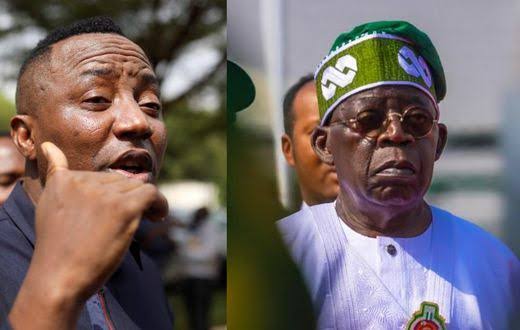
Human rights activist and African Action Congress (AAC) presidential candidate, Omoyele Sowore, has alleged that President Bola Tinubu may exploit Nigeria’s reported Ebola case to suppress voter turnout ahead of the 2027 general elections.
Sowore, who raised the concern in a statement issued on Wednesday, warned against using a public health emergency as a pretext to restrict civil liberties or undermine democratic participation.
In the statement titled, “The Ebola Disease: Why Nigerians Must Not Panic But Must Ask Political Questions,” the activist urged Nigerians to remain vigilant and demand transparency from the government in its handling of the outbreak.
He alleged that the administration might exploit the situation for political advantage, insisting that citizens had legitimate reasons to question the government’s preparedness, disease surveillance and coordination with international health authorities.
Sowore said Nigerians had raised concerns following the announcement that a woman who arrived in the country had tested positive for the Ebola virus.
He added that some citizens had questioned whether the government could use the outbreak to discourage voters from participating in the 2027 elections.
“These are questions Nigerians have every right to ask. I cannot put anything beyond Tinubu and his political agenda,” he said.
The activist further alleged that Tinubu could not win a genuinely free and fair election, urging Nigerians to resist any attempt to exploit a public health emergency to interfere with the electoral process.
He maintained that public health emergencies should never become excuses for restricting fundamental freedoms or preventing citizens from exercising their democratic rights.
Sowore also questioned Nigeria’s communication with Ugandan authorities concerning the travel and medical history of the woman diagnosed with the disease.
The concerns followed the confirmation of a case of Bundibugyo virus disease in the Federal Capital Territory (FCT) on October 20, 2026.
The Minister of Health and Social Welfare, Muhammad Ali Pate, reportedly announced the confirmation after laboratory tests established that a woman who arrived in Nigeria on an international flight had contracted the virus.
According to information released by Nigerian health authorities, 44 close contacts of the infected woman had been identified, with contact tracing initiated to determine others who might have been exposed.
The patient was reportedly admitted to a private hospital in the FCT, where she received treatment before laboratory tests confirmed the infection. She was subsequently placed in isolation for continued medical care.
The Federal Ministry of Health and Social Welfare said it was working with the Nigeria Centre for Disease Control and Prevention (NCDC), the FCT Health Services Secretariat and other relevant authorities to contain the infection and prevent further transmission.
However, Sowore questioned the state of Nigeria’s disease surveillance systems, emergency preparedness and international public health coordination, particularly the exchange of information with Uganda.
He cited reports that Uganda had clarified that the infected woman travelled to the eastern Democratic Republic of the Congo (DRC) for business before transiting through Uganda on her way to Nigeria.
Ugandan health authorities reportedly said the woman did not exhibit symptoms while in the country but developed them after arriving in Nigeria.
The authorities also stressed that her transit through Uganda did not establish that she contracted the virus there, adding that the location of exposure remained under investigation.
“Travel through Uganda does not establish that infection occurred here. The location of exposure remains under investigation,” the Ugandan Ministry of Health said.
The ministry reportedly stated that it was awaiting detailed information from Nigerian authorities about the woman’s travel itinerary and clinical history to guide further investigations and any necessary contact tracing.
Reacting to the reported delay in information-sharing, Sowore asked why Nigeria had not promptly provided the relevant details if the accounts were accurate.
He said the government needed to explain any gaps in communication that could undermine efforts to contain the disease, calling for transparency in the management of the outbreak.
The activist also criticised the reported appointment of President Tinubu’s Chief of Staff, Femi Gbajabiamila, to chair the Presidential Task Force on Ebola Preparedness.
Sowore questioned whether political leadership was being prioritised over the expertise of medical professionals in managing the public health emergency.
“Why should the political leadership of such a critical public health response take precedence over the expertise of qualified epidemiologists, infectious disease specialists, and public health professionals?” he asked.
He argued that the response should be driven by scientific evidence, professional competence and independent oversight rather than political considerations.
Sowore called for full disclosure of relevant information, effective contact tracing, appropriate medical intervention and adequate protection for frontline health workers.
He also urged the government to ensure that qualified medical experts played central roles in directing the response while demanding accountability from officials responsible for managing the outbreak.
Despite his criticism of the administration, the AAC presidential candidate urged Nigerians not to panic, stressing that Ebola required a coordinated and transparent response based on scientific evidence.
He said citizens should remain vigilant and continue to question the government’s preparedness without allowing fear to undermine their rights.
“Ebola is a serious disease that requires a coordinated, transparent, science-driven response. It must never be politicized, weaponized, or exploited to undermine civil liberties and democratic participation,” he said.
Sowore added that the government must prioritise public safety, transparency and accountability in its response to the outbreak.
“Public health must protect lives, not become an instrument of political control,” he said.