
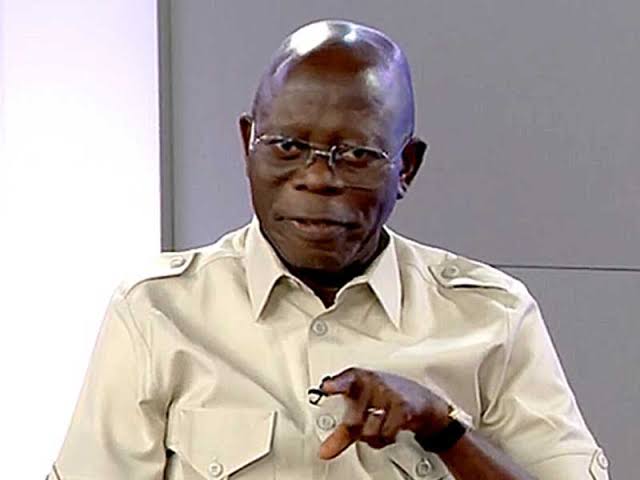
Former President of the Nigeria Labour Congress and ex-Governor of Edo State, Adams Oshiomhole, has called on Nigerian workers, civil society groups and citizens to stop lamenting over economic hardship and governance failures, urging them instead to organise collectively against policies and systems he said continue to sustain injustice, poverty and insecurity.
Oshiomhole made the call on Wednesday at the public presentation of the memoir of late labour leader and former NLC President, Hassan Sunmonu, titled Organise, Don’t Agonise.
According to him, Nigeria’s labour history shows clearly that no meaningful concession was ever granted by the state out of sympathy, but through sustained struggle, organisation and collective action.
“If it is wrong, fight for it. If you know it is wrong, fight for it. Don’t lament it,” Oshiomhole said. “We don’t win justice with tears or emotional speeches. Those who benefit from injustice don’t give it up out of goodwill. You have to organise and force change.”
Reflecting on past labour struggles, the former labour leader said the introduction of the national minimum wage was not a benevolent decision by government, but the outcome of intense pressure from organised labour that compelled the state to act.
“Minimum wage was not granted out of love. It was an admission by the state that things could not continue as business as usual,” he said. “When ₦125 was introduced and legislated, it laid the foundation for every subsequent wage struggle.”
Oshiomhole explained that the minimum wage was never intended to be a benchmark for responsible employers, but a protective floor for the most vulnerable workers.
“Minimum wage is not meant for well-organised employers or governments to celebrate themselves,” he said. “It is meant to protect those in sweatshops, those without walls, those without power. Governments and organised private sector employers are supposed to pay above it through negotiation.”
Drawing attention to current economic realities, he warned that inflation, currency devaluation and structural adjustment policies had steadily eroded workers’ incomes without any formal reduction in salaries.
“That is what we called invisible robbery,” Oshiomhole said. “Without touching your pay, your wages are destroyed through devaluation and structural adjustment. They said there was no alternative. But everything has an alternative. Even life.”
He also criticised what he described as deep structural injustice in Nigeria’s tax system, noting that low-income earners often bear the heaviest burden.
“Anybody earning below a living threshold should not be taxed,” he said. “But if we don’t get our facts right, those who benefit from injustice will say we don’t know what we are talking about.”
On the rule of law, Oshiomhole cautioned against equating legality with justice, recalling incidents where activists were brutalised by security agencies and later charged for offences committed against them.
“Justice and judgment are not the same,” he said. “Law is only as good as the quality of minds that make it. When the law is unjust, you must fight it. Bad laws are not the Bible or the Quran. They are the aggregation of the views of those who rule at a particular time.”
He called for stronger collaboration between the labour movement and progressive civil society organisations, insisting that meaningful reforms only occurred when both forces worked together.
“We work better when we stand with the progressive segment of civil society,” he said. “That was one of the greatest lessons of our struggle.”
Looking ahead to the next general election, Oshiomhole urged Nigerians to channel their frustrations into political and civic organisation rather than despair.
“We will not agonise over the death of democracy or the collapse of security. We will organise,” he declared. “We will challenge this government and all those that come after it to provide security, justice and dignity for Nigerians.”
He also spoke on the personal cost of activism, recalling years of arrests, detentions and prolonged absences from home, which he said took a toll on his family, especially his children, underscoring the sacrifices involved in the struggle for justice.
Describing Sunmonu’s book as more than a memoir, Oshiomhole said it served as a practical guide for younger generations on courage, consistency and principled struggle.
“This is not about money. It is about values,” he said. “It is about reminding the younger ones that nothing meaningful is handed to you. You must organise, stand firm and fight for it.”
Also speaking at the event, human rights lawyer and activist, Femi Falana, said Sunmonu lived a fulfilled life and charged the current leadership of the NLC to emulate his legacy by building a labour movement capable of reclaiming Nigeria for its people.
“This is one of the best countries in the world, yet 62 per cent of Nigerians have been classified as multidimensionally poor,” Falana said. “NLC, your job is cut out for you.”