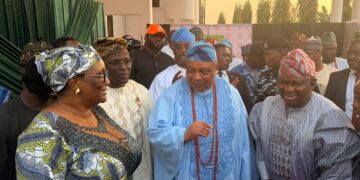

The Resident Electoral Commissioner of the Independent National Electoral Commission in Benue State, Professor Samuel Egwu, has said the absence of financial and institutional autonomy is crippling the effectiveness of State Houses of Assembly across the country.
Egwu stated this while delivering a Distinguished Annual Lecture titled “Strengthening Democratic Governance as a Catalyst for Sustainable National Security” at the end of the Senior Executive Course 47 of the National Institute for Policy and Strategic Studies, Kuru, Plateau State.
He expressed concern that many state assemblies operate at the mercy of governors, a situation he said has weakened legislative oversight and undermined democratic governance at the state level.
According to him, the lack of independence has continued to stifle governance and development, while also worsening the crisis of leadership at the local government level.
Egwu noted that although autonomy has been granted to state legislatures and local governments, it largely remains on paper, adding that the organic nature of the crisis in local governance demands a deliberate restructuring of governance priorities at the grassroots.
He said, “Local governance as driven by the UNDP piloted in the Niger Delta brings elected representatives of communities to identify priority needs of the communities, which are jointly implemented with funds from states and local government, while creating a sense of community ownership for sustainability.”
The INEC commissioner also drew attention to the weakened capacity of public service institutions, persistent corruption in the public sector, and the sharp decline in national values, warning that rising unemployment, poverty, and widening social inequality were creating fertile ground for threats to Nigeria’s democratic process.
He stressed the need to strengthen key democratic institutions, particularly political parties, the legislature, and anti corruption agencies, noting that these efforts must be complemented by support for civil society organisations to enable them play their watchdog role without undue interference.
“There is the need to provide strong safety nets in the face of aggressive market reforms that have effectively taken the state away from the people,” he said.
Egwu further argued that neoliberal market reforms undermine the social democratic and welfare foundations of the Nigerian state as provided in Chapter Two of the 1999 Constitution, insisting that democratic governance must remain people centered to guarantee sustainable national security.