



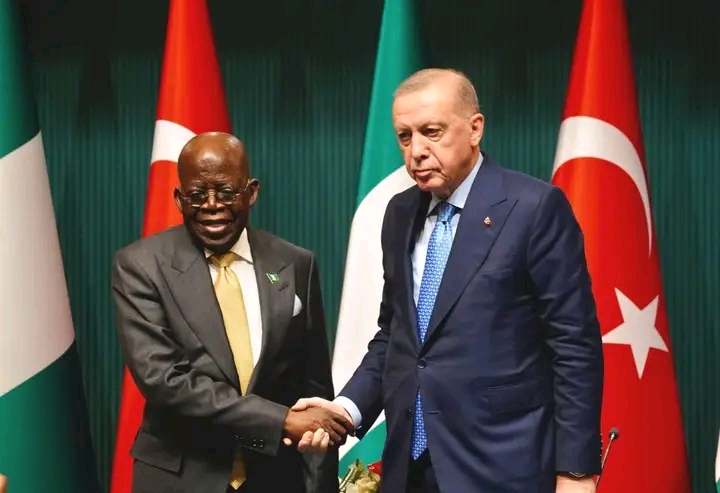
ANKARA, Turkey — Nigeria and Türkiye have set an ambitious target to increase bilateral trade to $5 billion, President Recep Tayyip Erdogan announced on Tuesday during a joint press briefing with Nigerian President Bola Ahmed Tinubu in Ankara.
The announcement comes amid President Tinubu’s state visit to Türkiye, where both leaders discussed ways to strengthen economic ties, boost investments, and deepen cooperation in areas such as energy, defence, education and media.
Current trade volume between the two countries stands at about $2 billion, with Türkiye exporting planes, helicopters, machinery, iron and steel, and chemical products to Nigeria, while Nigeria exports crude oil and agricultural products to Türkiye.
In a press release issued by the State House, Abuja, stated that discussions to actualise the $5 billion target have already commenced and that the establishment of a Joint Economy and Trade Committee would be crucial to expanding Turkish investments in Nigeria.
The committee is expected to provide a framework for strategic collaboration and follow-up on agreed projects.
President Erdogan said the $5 billion trade target reflects the “significant potential” that exists between the two nations, adding that the steps required to reach the goal were discussed during the meeting.
He said the new committee will create opportunities for Turkish businesses to invest more in Nigeria.
“Today, we conducted a comprehensive review of our relations with the esteemed President and his delegation in the fields of trade, investments, energy, education and defence industry,” Erdogan said.
“Firstly, we see that we have significant potential in the fields of trade and investment. In today’s meetings, our commitment is to the $5 billion trade volume target, and we discussed the steps needed.”
The Turkish President also commended President Tinubu’s drive to reform the Nigerian economy, particularly through progress in the energy sector.
He expressed optimism that cooperation between the Turkish Petroleum Corporation and Nigerian energy agencies would yield positive results.
Erdogan further pledged Türkiye’s support for Nigeria in its fight against terrorism, citing his country’s own experience with insurgency and extremism.
He said the leaders discussed enhanced collaboration in military training and intelligence sharing.
“Terrorist organisations emerging, particularly in Africa’s Sahel region, unfortunately, pose a threat to the peace of the entire continent. We stand by the friendly people of Nigeria in their fight against terrorism under the leadership of President Tinubu,” Erdogan said.
“We stated that we are ready to share our country’s significant experience in combating terrorism.”
He added that he expects positive outcomes from meetings between Nigerian officials and leading Turkish defence industry firms during the visit.
President Tinubu, for his part, expressed appreciation for Türkiye’s willingness to work with Nigeria in promoting global stability, freedom and shared prosperity.
He emphasised the need for inclusive economic growth that brings vulnerable citizens into the development process.
Tinubu said: “What is very important to the countries being discussed, trade, business, no restrictions, giving opportunity to those who are ready to learn to work and prosper. How do we build an inclusive economy together? How do we reform the economy and involve vulnerable people? How do we ensure peace in the world?”
He also assured that Nigeria will continue to play a key role in promoting peace and stability in Africa, despite security challenges in some parts of the country.
“We discussed efforts against terrorism. We discussed how to defeat agents of destabilisation,” Tinubu said.
Tinubu praised Erdogan’s commitment to global peace, particularly his efforts in Somalia, and reaffirmed Nigeria’s readiness to collaborate with Türkiye across multiple sectors.
At the end of the bilateral meeting, officials from both countries signed nine agreements covering various fields, including diaspora policy, defence cooperation, higher education, media and communication, halal quality infrastructure, and social development.
The agreements also included a joint declaration establishing the Economy and Trade Joint Committee, which is expected to play a pivotal role in achieving the $5 billion trade target.