




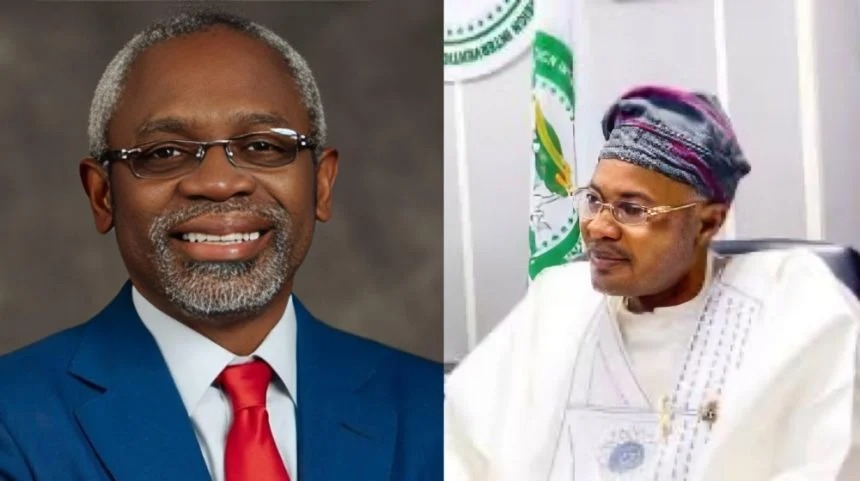
Political analyst and Chairman of the Ijebu North East Forum, Bayo Ayanga, has said only a competent court of law can determine the innocence or otherwise of the Chief of Staff to the President, Femi Gbajabiamila, in the ongoing controversy surrounding the alleged activities of the purported Presidential Foreign Intervention Promotion Council.
Ayanga also called on Gbajabiamila to temporarily step aside from office until the conclusion of the judicial process, arguing that doing so would uphold due process and strengthen public confidence in government institutions.
He stated this on Thursday during an interview on Frontline, a current affairs programme on Eagle 102.5 FM, Ilese-Ijebu, Ogun State.
His comments come amid the ongoing legal battle involving Gbajabiamila and a self-acclaimed Director-General of the PFIPC, Adeniyi Adeyemi Matthew, who is facing criminal charges over allegations bordering on forgery, impersonation and operating a fictitious government agency.
The Presidency had earlier dismissed allegations made by Adeyemi against the Chief of Staff, insisting that the PFIPC was not a recognised agency of the Federal Government and that Gbajabiamila had no constitutional powers to issue appointment letters.
However, Ayanga maintained that the Presidency lacked the constitutional authority to exonerate anyone facing criminal allegations.
“Femi Gbajabiamila will have to at least step down until this whole mess is cleared. Because the mess is not cleared yet,” he said.
According to him, true exoneration can only come through the judicial process.
“The honourable thing was for Honourable Femi Gbajabiamila to step down. The fact that the Presidency said he is cleared does not mean he is cleared yet. Until we see the end of this case and the court says this man is guilty or not guilty, that is the total clearance. I expect him to step down,” Ayanga stated.
Clarifying his position, the political analyst stressed that he was not advocating Gbajabiamila’s resignation.
“No, no. For him to step down pending him being cleared by the courts. I’m not saying he should resign,” he added.
Ayanga further argued that the Presidency’s public defence of the Chief of Staff could not replace the constitutional role of the courts in determining criminal liability.
“This is a criminal allegation. It is not a civil matter. If it is a criminal allegation that was made, then let the court clear the case,” he said.
He also questioned the speed with which the Presidency dismissed the allegations against the Chief of Staff.
“They were so swift about it. This allegation was made some days ago and then within a week we have cleared the man. How? How did they clear him?” Ayanga queried.
The analyst also said the controversy had exposed significant weaknesses in Nigeria’s governance and administrative systems, particularly within the civil service.
“There is a very great lacuna in the system of governance in Nigeria. I am not only talking about politicians, I am also talking about the civil service structure,” he said.
Ayanga wondered how an individual allegedly posing as the head of a non-existent government agency could secure office space within the Federal Secretariat, allegedly gain access to budgetary provisions and reportedly open accounts linked to government institutions.
“How did that happen? How did he enter into the 2026 appropriation? How did he present false documents to the CBN and then accounts were opened? Who are the signatories? Who paid money into those accounts? There are too many questions begging for answers,” he said.
According to him, regardless of the outcome of the ongoing trial, the controversy should compel the Federal Government to strengthen institutional safeguards and improve verification processes across public institutions.
“I don’t think this is wrong in itself because, at the end of the day, it should help foster better administration, better governance and institutional reforms that will ensure better ways of verifying information and official processes,” he said.
He added that the case revealed failures at multiple levels of government oversight.
“There are some things that, at the very first table, should have been knocked out. But it left that first table, got to the second, the third and even the highest table before getting approval. That tells you that something is fundamentally wrong with the verification process,” Ayanga stated.