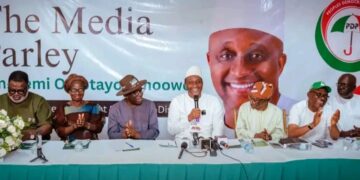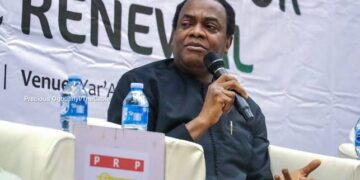




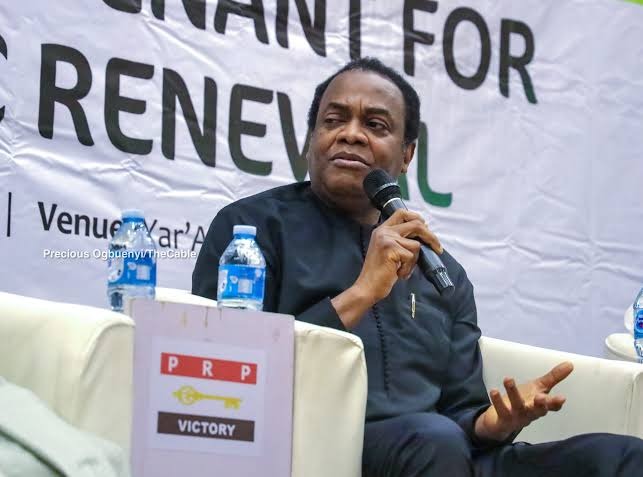
Former Cross River State Governor and presidential candidate of the People’s Redemption Party (PRP), Donald Duke, has said his ambition to become Nigeria’s president in 2027 is driven by his desire to build a better country, rather than personal fulfilment or the pursuit of political power.
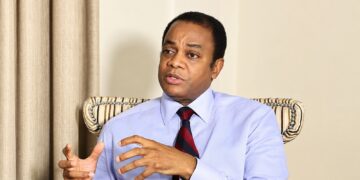
Duke stated this on Monday during an exclusive interview on Frontline, a current affairs programme on Eagle 102.5 FM, Ilese-Ijebu, Ogun State, where he explained that his political ambition was rooted in his vision to improve the living conditions of Nigerians and create opportunities for economic prosperity.
“I’m not in politics because I’m seeking actualisation. I’m in politics because I want to actualise a vision of a better Nigeria,” he said.
The PRP presidential candidate maintained that his eight-year tenure as governor of Cross River State provided evidence of his ability to translate political promises into practical results, urging Nigerians to assess candidates based on their records in public office.
“If I came into this race without a track record, then I’m making promises which may not be true. But if you dig deep enough, and examine my eight years as governor of Cross River State and what we were able to do out of little or nothing, then I think you’ll find me better disposed to keep my word,” he said.
Duke explained that his decision to contest on the platform of the PRP was informed by his desire to pursue his political vision without the compromises he associated with larger political parties.
According to him, political trade-offs within established parties could constrain leaders and limit their ability to implement their programmes effectively.
He argued that Nigeria’s fundamental challenge was not a lack of resources but the failure to harness its human and economic potential for the benefit of the majority of its citizens.
“What we would like to do is actualise the mass of our people,” he said, stressing the need to create jobs, improve livelihoods and expand economic opportunities, particularly for disadvantaged Nigerians.
Duke described Nigeria’s population as a major economic asset that could drive national development if properly engaged in productive activities.
“Our real strength is our numbers. Unfortunately, when not properly utilised or unutilised at all, it becomes our worst enemy,” he said.
He identified the promotion of citizens’ productivity within a safe and orderly environment as the central responsibility of government, arguing that policies should enable Nigerians to work, earn decent incomes and contribute meaningfully to economic growth.
“I’ve said over and over again that the critical function of government is to ensure the productivity of our people within a safe and orderly environment. That is the mission statement of our government. To ensure the optimal productivity of our people,” he said.
The former governor also called for urgent measures to address high interest rates and energy costs, which he described as major constraints on businesses, investment and economic expansion.
Duke questioned how the economy could grow under borrowing costs of about 38 per cent, arguing that the cost of credit and energy must be reduced to improve productivity and encourage private-sector investment.
“It is very, very urgent. We have to deal with the factors of production. We cannot have 38 per cent interest rate and expect the economy to grow. You have to deal with the biggest inflationary item in the book, which is your energy price,” he said.
On petroleum pricing, Duke proposed a domestic crude oil supply and refining arrangement aimed at making petrol and diesel more affordable for Nigerians.
He argued that crude oil owned by the Federal Government and not already committed to other buyers should be supplied to domestic refineries at cost, with additional charges covering contract refining, distribution expenses and a 10 per cent margin.
“Don’t sell your crude oil to traders. Sell it to your own local refinery here, the one that you have here, at cost. Sell it to them at cost. Charge them contract refining so that they refine it also at their cost,” he said.
According to him, the profits generated from other petroleum by-products could be used to moderate the prices of petrol and diesel, which affect transportation, food prices, electricity generation and business operations.
“The profits you make from the other four by-products, you use it to dampen the price of petrol and diesel. Because that is the fuel of your economy. That’s what makes the economy move,” he said.
While acknowledging the debate over fuel subsidies, Duke maintained that restoring an unsustainable subsidy regime was not the solution to rising petroleum prices. Instead, he called for policies that would make locally refined products affordable through a more efficient domestic supply and pricing framework.
“That is why I’m saying that people are talking of subsidy. But I’m saying you don’t need to do subsidy because it’s not sustainable. Subsidy is not sustainable. Right? But you need to make it affordable,” he said.