




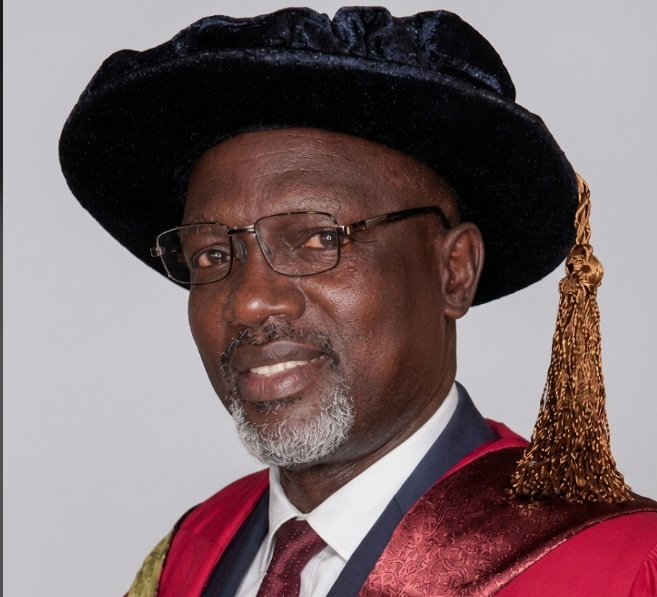
A theatre scholar and academic, Dr. Christopher Taiwo Omotosho, has said that Theatre Arts goes beyond acting and entertainment, describing it as a powerful instrument for social change, education and national development.
He stated this during the 8th lecture series organised by the School of Secondary Education (Arts and Social Sciences), held on Thursday at the Theatre Arts Complex, Federal College of Education, Abeokuta, Ogun State.
Omotosho, who spoke on the theme “gOD in the Theatre and Creative Authority”, explained that theatre practitioners occupy a critical space in society as creative agents who use performance and storytelling to shape values and correct social ills.
“Theatre practitioners serve as creative agents whose works are designed to educate, inform, inspire and correct societal ills,” he said.
He introduced the concept of “gOD in the Theatre” as a metaphorical representation of the playwright and other creative professionals, noting that they function as creators within the artistic space while drawing inspiration from the Supreme Being.
“The playwright is not merely a writer. He is a creator. He creates characters, events, conflicts and entire worlds that eventually come alive on stage through the collaborative efforts of other creative professionals,” he said.
The scholar also traced his journey into Theatre Arts, recalling his early exposure to travelling theatre troupes and community performances, which later shaped his academic pursuit after gaining admission into the University of Ibadan.
He explained that Theatre Arts is often misunderstood as being limited to acting and dancing, stressing that it offers wide professional opportunities across several fields.
“Many people still believe Theatre Arts is all about acting and dancing. The reality is that the discipline contains numerous professional pathways that extend into journalism, public relations, event management, fashion design, speech therapy, media production and graphic design,” he said.
Omotosho further maintained that theatre productions are intentionally designed to provoke reflection and drive behavioural change in society.
“The creations in theatre are meant to touch the hearts and minds of people. They are designed to inspire change, challenge wrongdoing and redirect society towards positive values,” he said.
He also highlighted Theatre for Development as a grassroots communication approach that uses indigenous languages and participatory performance to address community challenges.
Expressing concern over societal neglect of lessons embedded in Nigerian dramatic works, Omotosho said many warnings from playwrights have gone unheeded.
“There is virtually nothing happening in Nigeria today that our playwrights have not written about. Unfortunately, many of those lessons have been neglected, often at the expense of the welfare of ordinary citizens,” he said.
He paid tribute to prominent Nigerian playwrights including Wole Soyinka, Femi Osofisan, Ola Rotimi, Bode Sowande, Zulu Sofola, Olu Obafemi and Ahmed Yerima, describing them as creative voices committed to social justice and consciousness.
Concluding his lecture, Omotosho called for greater recognition of Theatre Arts as a vital instrument for nation building, cultural preservation and social transformation.
“The gODs in the theatre are extensions of the creative power of the Supreme God, creating purposefully for the betterment of society. Theatre remains a vital instrument for shaping a better future,” he said.