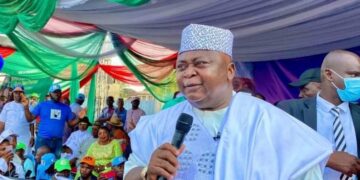





The Senior Political Assistant to former Vice President Atiku Abubakar, Demola Olarewaju, has expressed strong confidence that his principal will not lose the African Democratic Congress (ADC) presidential ticket, amid ongoing moves to build an opposition coalition around the party.
Olarewaju made the assertion on Monday during an interview on a current affairs programme on Eagle 102.5 FM, Ilese-Ijebu, Ogun State, where he spoke extensively on Atiku’s political journey and his role in Nigeria’s democratic space.
He said the emerging coalition within the ADC is not driven by personal ambition but by what he described as a broader convergence of political interests aimed at strengthening opposition politics.
According to him, Atiku’s long history in politics shows a consistent pattern of accepting party decisions and respecting internal democratic processes.
He traced Atiku’s political background to the early 1990s, recalling his governorship ambition in 1992 during the military transition era, which was cut short by political disqualifications that reshaped the contest at the time.
Olarewaju said the development opened space for younger politicians to step forward, adding that Atiku’s emergence into presidential politics was influenced by his political mentor, Shehu Musa Yar’Adua.
He noted that Atiku later contested the presidential primaries of the Social Democratic Party (SDP), where he came third behind M.K. Abiola and Babagana Kingibe, describing it as a defining moment in his political career.
He said, “That was the beginning of his politics that establishes him as a democrat.”
Olarewaju added that Atiku’s willingness to accept outcomes has remained consistent over the years, citing the 2011 PDP presidential primary, which he lost to then President Goodluck Jonathan, and the 2015 APC primary, which he lost to Muhammadu Buhari.
He stated that in both cases, Atiku supported the eventual candidates in the general elections, describing the conduct as evidence of political maturity and loyalty to democratic principles.
He argued that such a record makes it easy to understand Atiku’s current position within the ADC coalition, stressing that he remains committed to party decisions regardless of outcomes.
Olarewaju also compared Atiku’s political style with other politicians, arguing that some actors have not demonstrated similar post-election restraint, a reference he linked to developments after the last general election.
He maintained that democracy requires both the ability to win and the willingness to accept defeat, insisting that Atiku embodies that principle.
On the 2027 political outlook, Olarewaju dismissed concerns about Atiku’s age, saying leadership should be judged by competence, sound mind and physical capacity rather than numerical age.
He argued that Nigerians should prioritise governance delivery over sentiment, adding that the real issue is who can address insecurity, economic hardship and national development challenges.
Olarewaju expressed confidence that the ADC coalition process would favour Atiku, insisting he does not foresee him losing the party’s presidential ticket.
He, however, maintained that in the event of any contrary outcome, Atiku would still support whoever emerges, describing it as part of his democratic disposition.