



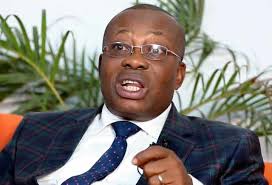
A Senior Advocate of Nigeria, Dr Monday Ubani, has accused state governments of interfering in local government allocations, warning that the practice is worsening poverty and underdevelopment in rural communities across the country.
Ubani made the allegation during an interview on Frontline, a current affairs programme on Eagle 102.5 FM, Ilese-Ijebu, where he linked the hardship experienced at the grassroots to what he described as systemic diversion and withholding of funds meant for local governments.
The immediate past Chairman of the Nigerian Bar Association Section on Public Interest and Development Law stated that local governments were constitutionally entitled to direct funding, but lamented that the principle was being undermined in practice.
According to him, withholding or redirecting local government allocations had made meaningful development at the community level almost impossible.
“The suffering experienced in rural communities across Nigeria is not accidental but linked to systemic interference with local government funds,” Ubani said.
He added, “If the state governors are releasing the money meant for local governments, Nigeria would be a beautiful country.”
The senior lawyer argued that the consequence of the practice was evident in many rural communities where roads, electricity and other basic infrastructure remained absent.
Ubani noted that many residents of rural areas were relocating to urban centres because governance was no longer felt at the grassroots.
He stressed that local governments were meant to be the closest tier of government to the people and should play a critical role in delivering development.
The SAN, however, lamented that local councils had been financially strangled through state-level control of their allocations.
According to him, the development had weakened service delivery in healthcare, education and rural infrastructure.
Ubani said the lack of functional local government autonomy had created a vacuum in grassroots governance, which he blamed for worsening poverty across rural Nigeria.
“What Nigerians require is just good roads and light, especially in the rural areas,” he said.
He maintained that local governments would be able to provide such basic amenities if funds allocated to them were properly released and utilised.
Ubani also criticised what he described as misplaced priorities in governance, arguing that more attention should be paid to rural electrification and road connectivity instead of concentrating on mega projects.
He said decentralised development remained essential to reducing inequality between urban and rural communities.
The senior advocate further linked weak local governance structures to Nigeria’s broader economic hardship.
“There is so much money being allocated, but the local governments are not getting it,” he said.
Ubani maintained that proper disbursement of local government funds would stimulate rural economies, reduce urban migration and improve living conditions at the grassroots.
He added that accountability and transparency in the distribution of public funds remained weak across different tiers of government.
“Nigerians are not lazy,” Ubani stated, adding that citizens only needed enabling infrastructure and effective governance to thrive.
He concluded that Nigeria’s development challenges were more connected to poor management of available resources than lack of funds, insisting that strengthening local government autonomy remained critical to balanced national development.