



By Kayode Akinmade
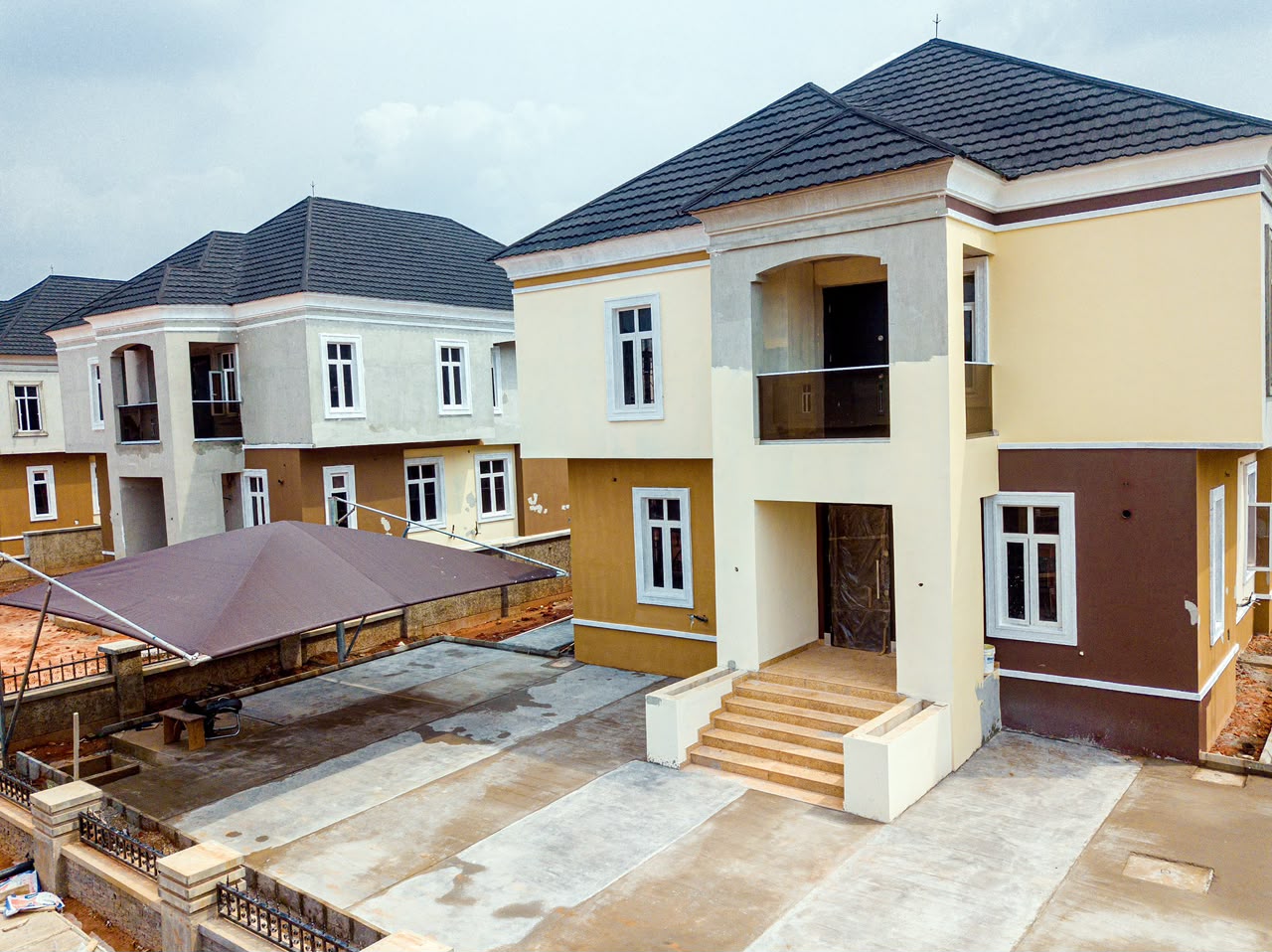
Drive along the Siun-Sagamu Expressway today and it is easy to miss how recently the landscape around Kobape was little more than open bush. Today, standing prominently on that corridor is Prince Court Estate — a thriving residential community of completed and occupied homes, with its own electricity supply, shopping mall, health centre, ATM gallery and security post.
It is more than an estate.
It is a statement of what housing policy can become when it is conceived not merely as the provision of shelter, but as an instrument of economic development, urban renewal and wealth creation.
That is perhaps the most important story behind the housing transformation taking place quietly across Ogun State under Governor Dapo Abiodun.
When the first phase of Prince Court Estate took shape at Kobape, few would have imagined that it would become the anchor of a rapidly developing residential corridor. The estate has since expanded through four phases, while the surrounding area has recorded significant growth in residential and commercial activity.
The model has subsequently been replicated across the state.
From Idi-Aba in Abeokuta to Sagamu, Itanrin in Ijebu-Ode, Ilaro and the Gateway Aviation Village at Iperu, the Abiodun administration has deliberately spread housing development across Ogun’s three senatorial districts.
The objective is clear: to ensure that the benefits of Ogun’s rapid economic expansion are reflected not only in factories, roads and commercial investments, but also in the quality and availability of homes for the people who live and work in the state.
Housing as economic policy
The significance of the programme lies in its architecture.
The Abiodun administration has approached housing as both a social responsibility and an economic asset. Its portfolio cuts across affordable housing for ordinary families, premium housing for middle- and high-income earners, public-private partnerships, urban regeneration and the redevelopment of underutilised government assets.
The first phase of the Kemta, Idi-Aba scheme, comprising 150 two- and three-bedroom homes, sold out rapidly. That response was an early indication of the enormous pent-up demand for decent and affordable housing in Ogun.
At Kobape, some of the early Prince Court homes were sold to civil servants and members of the public for between about N4.95 million and N5 million. According to figures provided by the state’s housing authorities, similar properties are now worth substantially more on the open market.
That transformation is significant.
It means the government’s intervention did not simply put roofs over people’s heads. For many early beneficiaries, it created an appreciating asset and opened a pathway to household wealth.
In a country where housing remains one of the biggest barriers to economic security for working families, that is a powerful dimension of public policy.
From estates to communities
The most striking feature of the Ogun model is that the government has not treated housing as the construction of isolated blocks of buildings.
Prince Court illustrates the philosophy.
Electricity, healthcare, security, banking and commercial facilities have been integrated into the development, creating a community rather than merely an estate.
That approach matters because modern housing policy is ultimately about the quality of life around the house.
A home without reliable infrastructure, access roads, security, healthcare, commerce and other essential services can quickly become another form of urban vulnerability. But when housing is integrated with these services, it becomes the foundation for a functional community.
This is where the Ogun intervention acquires a broader development significance.
Housing generates demand for roads, electricity, water, retail, transportation, security and other services. Construction itself creates jobs across a long chain of activities involving artisans, engineers, architects, surveyors, suppliers, manufacturers, estate managers and financial institutions.
Every new estate therefore has an economic footprint that extends well beyond the walls of the individual houses.
Unlocking forgotten public assets
The administration’s housing philosophy is perhaps even more evident in its urban regeneration projects at Ibara in Abeokuta and Igbeba in Ijebu-Ode.
For decades, more than 200 civil servants’ quarters constructed over 50 years ago had deteriorated and become largely unusable across approximately 25 hectares of valuable government land.
The Abiodun administration chose not to allow those assets to continue decaying.
Instead, it moved to replace obsolete structures with modern buildings, producing more than 250 smart buildings across the two locations.
The policy significance is substantial.
Government land in prime urban locations is a finite public asset. When buildings on such land become obsolete and unusable, the state faces a choice: continue spending scarce resources maintaining failing structures or redevelop the land in a way that creates new value.
Ogun chose the latter.
The result is not simply new housing. It is the conversion of underutilised public land into productive urban assets, while simultaneously modernising the physical character of some of the state’s most important government layouts.
That is urban regeneration with a balance sheet.
A programme still gathering momentum
Far from winding down, the programme is expanding as the Abiodun administration enters the final stretch of its tenure.
The Ogun State Executive Council has approved another package of projects comprising 450 two-bedroom semi-detached bungalows with supporting infrastructure, 28 official quarters for members of the Ogun State House of Assembly, 28 sellable duplexes at the Ibara Government Reservation Area Scheme II and the reconstruction of the Ogun State Governor’s Lodge in Asokoro, Abuja. (Trending News)
Taken together, the approvals reveal the breadth of the administration’s housing and urban-development strategy.
The 450 bungalows will expand the supply of affordable housing. The Assembly quarters will provide modern accommodation for legislators and preserve institutional assets. The 28 Ibara GRA duplexes will unlock further value from a prime government location, while the reconstruction of the Governor’s Lodge will preserve an important state asset and provide a modern institutional facility.
The projects also reflect a broader government policy of replacing obsolete public infrastructure with modern, functional and durable facilities capable of serving the needs of a growing state.
That policy is particularly relevant to public housing and government quarters inherited from previous decades. Where structures have become severely degraded and rehabilitation is no longer economically sensible, redevelopment offers an opportunity to create more valuable, efficient and sustainable assets.
The new housing projects, meanwhile, extend the administration’s affordable-housing intervention while stimulating activity across the construction value chain.
From contractors and engineers to artisans, manufacturers, suppliers and service providers, housing construction generates employment and creates demand across multiple sectors of the economy.
The Ibara GRA Scheme II duplexes add another dimension: the strategic use of prime public land to generate modern residential assets, attract private investment and strengthen the value of the state’s property portfolio.
In that sense, the latest approvals are not isolated construction projects. They are part of a deliberate policy of combining housing delivery with urban regeneration, institutional development and asset optimisation.
The numbers behind the ambition
The scale of the intervention is reflected in the numbers.
At a briefing in January on the 2026 housing roadmap, the Commissioner for Housing, Jamiu Akande Omoniyi, disclosed that Ogun planned to deliver no fewer than 3,000 additional housing units in 2026, backed by more than N100 billion allocated to the housing sector. The plan forms part of the administration’s broader ambition to deliver 10,000 housing units by 2027. (Punch Newspapers)
The commissioner had also said that more than 4,000 affordable housing units were delivered between 2019 and 2023, with additional units subsequently taking the reported delivery figure above 5,000.
The numbers are important not simply because they represent houses. They represent the scale of public intervention required to respond to a rapidly growing state whose strategic location next to Lagos continues to drive population growth, industrialisation and investment.
Ogun’s housing challenge is therefore inseparable from its economic success.
As more factories, businesses and people move into the state, demand for housing will increase. A government that fails to anticipate that demand risks allowing economic growth to produce housing shortages, informal settlements and uncontrolled urban expansion.
The Abiodun administration’s response has been to get ahead of that curve.
Housing the workforce of a growing economy
There is also a strategic economic dimension to affordable housing.
Ogun has positioned itself as one of Nigeria’s leading investment destinations, with major industrial clusters and expanding commercial activity. But investors do not operate in isolation. Workers need homes. Families need schools and healthcare. Businesses need functioning communities around them.
Housing is therefore part of the infrastructure of investment.
By expanding residential communities around major growth corridors, government is helping to create the conditions for a more balanced relationship between where people work and where they live.
That has implications for productivity, commuting, family welfare and the long-term sustainability of urban growth.
It is why the state’s housing programme should not be viewed as a collection of government estates scattered across Ogun.
It is part of the broader infrastructure supporting the state’s economic transformation.
The legacy taking shape
Perhaps the clearest evidence of the programme’s significance is the way individual projects have begun to alter their surrounding environments.
Kobape is a case in point.
What began as a housing project has become part of a broader residential and commercial ecosystem. The same principle is now being applied in other parts of the state, while the regeneration of Ibara and Igbeba demonstrates that the administration is also looking inward — renewing old government assets rather than endlessly expanding into new land.
This is the policy legacy taking shape.
Governor Abiodun’s housing programme has evolved from providing houses to creating communities; from constructing buildings to unlocking land value; from meeting immediate shelter needs to supporting economic growth; and from developing new estates to regenerating ageing urban centres.
The ambition to reach 10,000 housing units is therefore more than a numerical target. It represents an attempt to institutionalise a housing culture in which government, private developers and residents all participate in expanding the state’s housing stock.
And the programme is not being designed merely as a legacy of photographs and commissioning ceremonies.
The administration has repeatedly affirmed its determination to complete the projects it has initiated before the end of its tenure.
That distinction matters.
A legacy is not defined by what a government announces. It is defined by what remains standing, occupied, functional and valuable after the government has left.
Across Kobape, Kemta, Idi-Aba, Sagamu, Ijebu-Ode, Ilaro, Iperu and the regeneration sites at Ibara and Igbeba, the evidence is increasingly visible.
The quiet transformation of Ogun’s housing sector is, in reality, part of a much larger story — one in which housing has been repositioned from a welfare item on a government balance sheet to an engine of urban renewal, economic participation, asset creation and social stability.
That may ultimately be one of the most enduring dimensions of the Dapo Abiodun legacy.