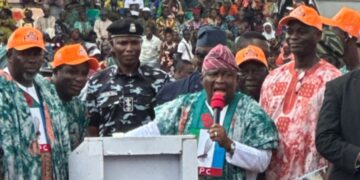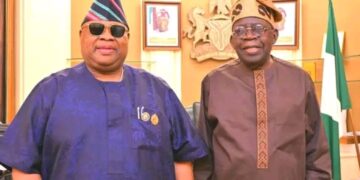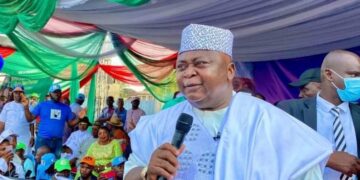


Former President Chief Olusegun Obasanjo has revealed how he and then President, Dr Goodluck Jonathan, opposed the emergence of Aminu Tambuwal as Speaker of the House of Representatives during the 2011 leadership contest.
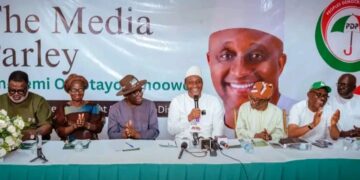
Obasanjo made the disclosure in Abuja at a leadership colloquium and 60th birthday celebration organised in honour of Tambuwal, held at the Congress Hall of the Transcorp Hilton Hotel. He said the resistance against Tambuwal’s emergence, as well as that of Emeka Ihedioha as Deputy Speaker, was driven by party considerations and the desire to promote gender inclusion in the leadership of the National Assembly.
The former president, who later became Chairman of the Board of Trustees of the Peoples Democratic Party, explained that the PDP leadership preferred a different outcome in the interest of internal party balance. He noted that the party believed it was time to encourage female representation at the highest level of the House of Representatives.
“Our thinking was that if, for the first time, a woman had become Speaker of the House, she should be encouraged to remain there,” Obasanjo said. “But your members thought otherwise, and you made your decision. And we supported your decision. Initially, even you were not sure of where we would stand, but we stood with you.”
Despite the opposition, Tambuwal, who represented the North West, emerged Speaker after defeating Mulikat Akande-Adeola from the South West in a keenly contested election. Checks later revealed that lawmakers of the defunct Action Congress of Nigeria voted en masse for Tambuwal, following a directive by the party’s leader at the time, Bola Ahmed Tinubu.
Obasanjo said the eventual rebellion by PDP lawmakers was an assertion of the independence of the legislature. He described Tambuwal, now the senator representing Sokoto South, as warm, humble and capable of holding diverse interests together.
Speaking at the event, former President Jonathan admitted that his administration had disagreements with the leadership of the House while Tambuwal was Speaker. He, however, praised Tambuwal’s leadership qualities.
“When he was Speaker, I was the President, and we had some disagreements,” Jonathan said. “But one thing I must give to Tambuwal is that members of the House believed so much in him. He held the House together, and I appreciated that quality of leadership, even when we disagreed.”
Former Senate President and current Chairman of the African Democratic Congress, Senator David Mark, also confirmed that he was aware of the rebellion that led to Tambuwal’s emergence. He said he chose to respect the independence of the National Assembly, even when it meant going against party directives.
“They came to me and said, ‘Sir, whether you like it or not, you are adopting us as your sons,’” Mark recalled. “They told me clearly that whether the President and the party wanted them or not, they would emerge Speaker and Deputy Speaker, and that I would sponsor them. For once, Mr President, I disobeyed you.”
Former Vice President Atiku Abubakar described Tambuwal as a leader in the making, expressing hope that he would continue to live up to national expectations. Former Labour Party presidential candidate, Peter Obi, also praised Tambuwal, describing him as a man committed to national unity and consensus building.
Mulikat Akande-Adeola, the PDP’s preferred candidate who lost the contest, said she bore no grudges over the outcome. “Only what God wills comes to pass,” she said. “Tambuwal has been Speaker and a leader. There is no animosity among us.”
In his remarks, Tambuwal expressed concern over growing public apathy towards government, which he attributed to poor governance and the imposition of leaders. He urged the political elite to reflect deeply on the consequences of such practices.
The event was attended by several prominent political figures, including Senate President Godswill Akpabio, represented by the Senate Minority Leader, Senator Abba Moro; Catholic Bishop of Sokoto Diocese, Matthew Hassan Kukah; former Speakers Patricia Etteh and Yakubu Dogara; and Minister of Housing, Ahmed Musa Dangiwa.
Others included former governors Rotimi Amaechi, Kayode Fayemi, Aminu Masari, Udom Emmanuel, Rauf Aregbesola, Ibikunle Amosun, Gbenga Daniel, and former Deputy Speaker Emeka Ihedioha.