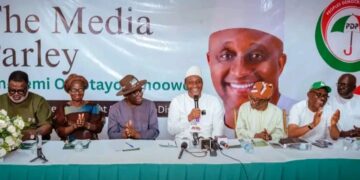


Rivers State elders and civil society organisations have strongly condemned the impeachment notice issued against Governor Siminalayi Fubara and his deputy, Prof. Ngozi Odu, describing the move as politically motivated, constitutionally weak, and capable of plunging the state into fresh instability.
The condemnation came under the umbrella of the Rivers Elders and Leadership Forum, which said impeachment is a grave constitutional procedure that must never be reduced to a tool for political vendetta or factional rivalry.
In a statement signed by the Acting Chairman of the Forum, Dr. Gabriel Toby, the elders said the reasons advanced so far in support of the impeachment move were alarmingly deficient and lacked public interest justification.
Dr. Toby, a former deputy governor of the state, said, “Impeachment is a serious constitutional process, not a weapon for settling political scores. The reasons so far advanced in support of this action are disturbingly weak, lacking substance, public interest justification, or constitutional weight.”
He noted that the action appeared driven by narrow personal interests rather than any genuine concern for good governance or accountability.
The elders reminded members of the Rivers State House of Assembly that Governor Fubara’s mandate was freely given by the people and can only be challenged through strict adherence to constitutional provisions and due process.
“The Governor’s mandate was freely given by the people of Rivers State and can only be questioned in strict compliance with constitutional provisions, due process, and on the basis of clear, compelling, and verifiable grounds,” the statement read.
Warning of the wider consequences, the Forum said the impeachment move could deepen political divisions, weaken public trust in democratic institutions, and destabilise an already fragile political environment.
“Rivers State has not fully recovered from the political, social, and institutional disruptions of the recent period of emergency rule. Our people continue to bear the consequences of that episode, and this development risks reopening old wounds and heightening tensions at a time when stability and focused governance are urgently needed,” the elders warned.
They called on lawmakers to immediately retrace their steps and place the peace, unity, and progress of the state above partisan or personal considerations.
“The Rivers Elders and Leadership Forum remains firmly committed to peace, unity, justice, and constitutional democracy in Rivers State. We will not be silent in the face of any action that threatens the stability, dignity, and future of our state,” Toby added.
Meanwhile, reactions to the impeachment saga have continued to trail across the state and beyond. A former Commissioner for Information and Communications in Rivers State, Austin Tam George, accused the Minister of the Federal Capital Territory, Nyesom Wike, of allegedly reducing governance to personal control.
George, who spoke during an interview on ARISE News, described the impeachment notice against Governor Fubara as “dead on arrival,” insisting that it lacked any constitutional or legal basis.
He said the move was purely political and aimed at stopping what he described as the governor’s growing popularity across the state.
According to him, the impeachment effort was triggered by Fubara’s recent defection to the APC, which he said had weakened the political leverage previously enjoyed by the Wike camp.
“The defection of the governor has obviously threatened the original leverage that the Wike camp had, and they are now trying to reassert that leverage,” George said.
He added, “Nyesom Wike has been a complete pestilence on Rivers State. I served in his administration. I resigned precisely because of his propensity for chaos, instability, and reducing government to a personality cult.”
Civil Society Organisations also joined in condemning the impeachment move, describing it as anti democratic and a misuse of legislative powers.
In a statement signed by the Chancellor of the International Society for Social Justice and Human Rights, Dr. Omenazu Jackson, alongside a separate statement by the Civil Liberties Organisation signed by its Rivers State Chairman, Sunny Dada, and Secretary, Dr. Christian Onyegbule, the groups described the impeachment threat as constitutionally reckless.
Dr. Jackson stressed that impeachment is not a political weapon but a serious constitutional process governed by Section 188 of the 1999 Constitution as amended.
He said the law requires clear allegations of gross misconduct, due process, fair hearing, legislative quorum, and a judicial panel investigation, warning that any deviation would render the process null and void.
The groups cautioned what they described as political opportunists and crisis merchants against actions capable of plunging the state into turmoil, warning that the patience of the people should not be mistaken for weakness.
Similarly, the CLO recalled that it had earlier urged the governor to present the state budget for legislative action, noting that impeachment should serve as a safeguard for accountability, not an instrument of political retaliation.
The organisation demanded strict adherence to constitutional provisions, standing rules, and judicial precedents.
Adding a legal perspective, a former Chairman of the Nigerian Electricity Regulatory Commission, Sam Amadi, said due judicial process remains Governor Fubara’s strongest shield against impeachment.
Speaking on ARISE News, Amadi said the appointment of an investigative panel by the Chief Judge of the state is the critical stage of the impeachment process.
“The main anchor for the impeachment procedure is the appointment by the Chief Judge of the state investigators. That is really the anchor point. If you don’t get there, you are gone,” he said.
He added that the grounds for impeachment were not legally overwhelming, saying, “Some would say it’s really trash. But the judge will be the saving point here, because he will appoint people of integrity who are not politically partisan.”
Amadi explained that such a panel would objectively examine whether the governor committed any act that amounts to gross misconduct, concluding that the judicial phase could ultimately shield Fubara from removal.