



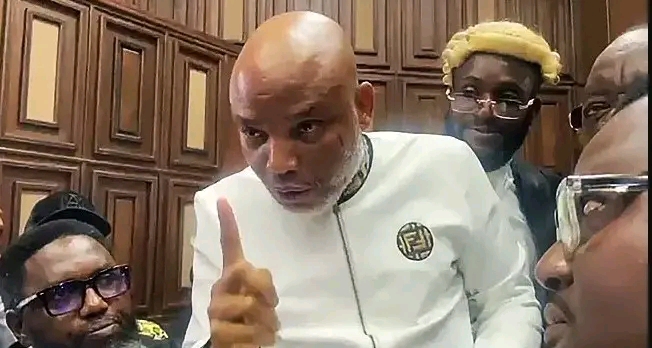
A Federal High Court in Abuja has sentenced the leader of the Indigenous People of Biafra, Nnamdi Kanu, to life imprisonment after convicting him on seven terrorism-related charges in a case that has stretched across several years and stirred intense debate about separatist movements, state power and the right to self-determination.
The ruling was delivered on Thursday by Justice James Omotosho, who held that the prosecution successfully proved that Kanu’s broadcasts and directives to members of his now-banned group triggered violent attacks on security agents and civilians in the southeast.
The judge said the attacks were tied to his push for an independent Biafra, a long-standing demand in the Igbo-dominated region.
While addressing the court, Justice Omotosho acknowledged that “the right to self-determination is a political right”, but added that it must operate strictly within the constitution.
He explained that any attempt to pursue it outside the framework of the law “is illegal”. Prosecutors had pushed for the death penalty, but the judge said he decided against it because “the death penalty is now being frowned upon by the international community”.
He chose to impose life imprisonment, which he described as a more fitting sentence “in the interests of justice”.
Kanu, who has ninety days to file an appeal, was removed from the courtroom moments before the judgment after he raised strong objections to the proceedings.
He accused the court of bias and insisted that his arrest in Kenya and subsequent transfer to Nigeria in 2021 were unlawful.
His legal team has repeatedly maintained that the circumstances surrounding his return violated international norms and tainted the entire trial.
The separatist leader has been in custody since June 2021, following his detention in Kenya, where his lawyer said he was mistreated.
Kenyan authorities have consistently denied involvement in any forced rendition.
Kanu first faced arrest in Nigeria in 2015 but fled the country while on bail. During his time abroad, his social media posts and regular Radio Biafra broadcasts sharply criticised the Nigerian government and former President Muhammadu Buhari.
Authorities said the remarks encouraged violent confrontations and shaped the atmosphere of unrest that marked several communities in the region.
His defence team has also argued that his statements on Radio Biafra, made while he was in London, should not be used as evidence in Nigeria.
In October 2021, his lawyer, Ifeanyi Ejiofor, said, “I can’t see how someone would make a statement in London and it becomes a triable offence in this country”.
Kanu, a dual Nigerian-British citizen, founded Radio Biafra in 2009 after leaving Nigeria to study economics and politics at the London Metropolitan University.
The station became a platform for his advocacy, including controversial statements such as: “We have one thing in common, all of us that believe in Biafra, one thing we have in common, a pathological hatred for Nigeria. I cannot begin to put into words how much I hate Nigeria.”
The demand for a separate Biafra state has lingered for decades. IPOB insists that only an independent country can address historical grievances and political marginalisation in the region.
The last major attempt to secede in 1967 led to a three-year civil war that killed more than one million people.
Following the latest verdict, groups aligned with the Biafra movement have vowed to challenge the judgment. Supporters say the conviction strengthens their resolve to pursue their cause through legal and political means.
They insist that Kanu’s agitation remains a political struggle and should not be treated as terrorism.
With tensions rising across the southeast, all eyes now turn to the appellate courts as Kanu’s legal team prepares for the next phase of a case that continues to shape national discourse.