



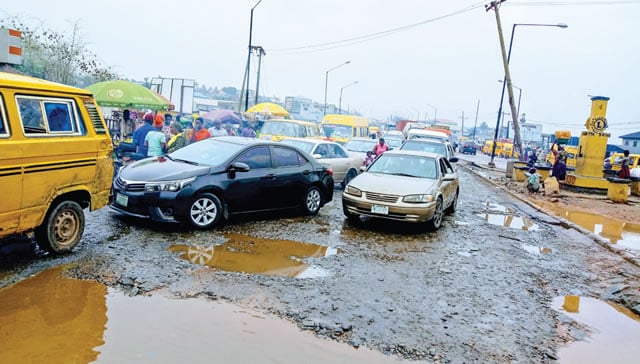
Ogun residents have expressed anger over the state of roads across the state, faulting the defence offered by one of Governor Dapo Abiodun’s aides on the government’s record in road development.
The backlash followed a social media post by the governor’s media aide, Mabeweje Tayo, titled “Governor Dapo Abiodun Is Fixing Ogun’s Roads, One Step at a Time.” In the post, Tayo argued that it was unrealistic to expect any governor to fix all roads in Ogun State within one or two tenures.
He explained that Abiodun inherited what he called “a landscape of forgotten roads and frustrated communities” and had since been working to “connect communities, open economic corridors, and ensure that every part of Ogun feels the impact of good governance.”
Tayo maintained that the administration had constructed or rehabilitated over 1,200 kilometres of roads across Ogun’s three senatorial districts. He said the governor had ensured even distribution of projects across Ogun East, Ogun Central, and Ogun West, describing the effort as “remarkable in its sense of balance and fairness.”
However, residents across the state dismissed his statement as an attempt to defend failure, insisting that their daily experiences on dilapidated roads proved otherwise.
“Lies from the pit of hell,” wrote one resident, David Oluwafemi, on Facebook. “How on earth can citizens move forward if we decide to celebrate an underperforming government?”
Another user, Adegoke Arodun, described the aide’s post as “a demonic write-up,” listing areas such as Ayobo-Lafenwa, Itele, Ayetoro-Tele, Ota, and Ewu as communities suffering daily hardship due to poor road conditions.
For Olurotimi Shokunbi, Ogun’s road network is worse compared to neighbouring states. “Even Oyo State, particularly Ibadan, has better roads, including inner streets. Ogun is richer, yet we lag behind,” he said.
Some residents also questioned the accuracy of the 1,200-kilometre claim, saying it was too small for an administration that promised massive infrastructure. Others mentioned neglected areas like Ipaja-Ayetoro, Obada, and Ijoko-Lambe, where residents struggle daily to move vehicles through deep potholes.
“If you live here, you don’t need anyone to tell you how bad things are,” a trader in Ijoko said. “Every day, we push cars out of holes. What we need is real work, not press statements.”
Responding, Tayo explained that some of the worst-hit roads, including the Lagos–Abeokuta and Sango–Ota corridors, were federal roads. He said the state had repeatedly sought permission from the Federal Government to repair or take over the roads but was delayed due to approval and funding issues.
He also claimed that ongoing road projects had improved investor confidence, saying the same roads that once hindered trade were now attracting new businesses and creating jobs.
But residents remain unconvinced. One commuter said bluntly that “Dapo Abiodun has not justified why he is governor of Ogun State. Ogun West has not benefitted from his government.”
Experts believe the problem goes beyond politics. Ogun State, they say, bears a heavier responsibility for maintaining federal roads due to its closeness to Lagos and its role as a major industrial route.
A senior urban planner in Abeokuta noted that while some projects might be ongoing, the issue was also about perception. “People want to see roads they can drive on, not just read about,” he said.
Despite the outrage, government aides insist that the administration’s development plan is well-distributed and sustainable. “We’re not working for applause,” one aide said. “We’re building for continuity and the future.”